The Changing Landscape of Paid Advertising in 2026
Paid advertising has changed significantly in recent years. Businesses are no longer measuring success only through clicks and impressions. In 2026, advertising platforms are becoming more AI-driven, focusing on automation, audience signals, conversion quality, and revenue impact.
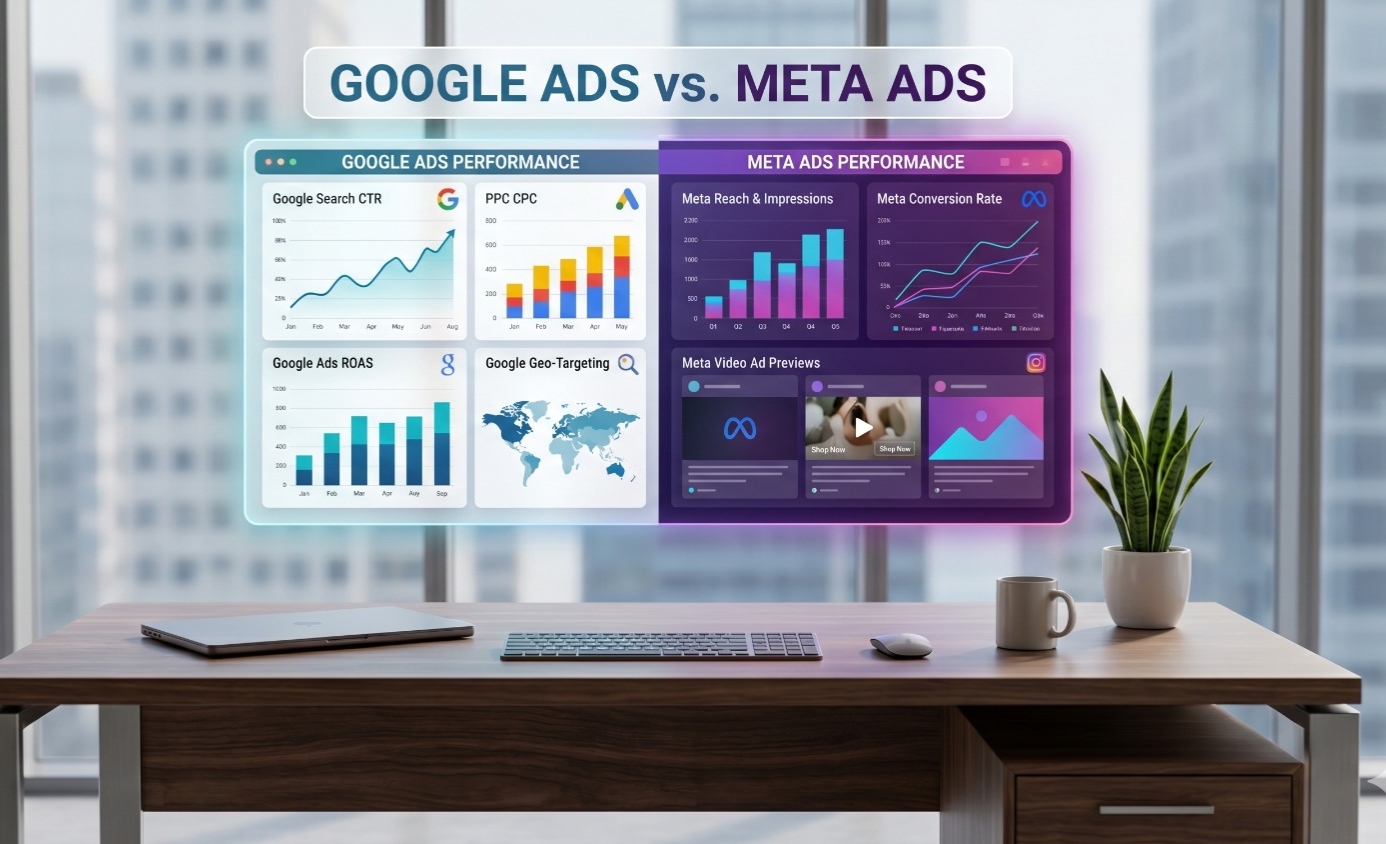
When comparing Google Ads vs Meta Ads, it is important to understand that both platforms measure performance differently based on user intent and campaign goals. Google Ads and Meta Ads remain two of the biggest platforms for digital advertising, but they work in different ways. Google Ads helps businesses capture existing demand by targeting users actively searching for products or services, while Meta Ads focuses on creating demand through social discovery, interests, and engagement.
To achieve better campaign results, marketers need to analyse the right Google Ads vs Meta Ads, understand their differences, and identify which performance indicators truly influence business growth and ROI.
Google Ads vs Meta Ads: Understanding the Core Difference
Google Ads and Meta Ads serve different purposes in a customer journey.
Google Ads is mainly a high-intent advertising platform. Users search for keywords because they already have a problem or need. This makes Google Ads highly effective for lead generation, e-commerce sales, and service-based businesses.
Meta Ads, including platforms like Facebook and Instagram advertising, are more focused on audience discovery and brand building. Users are not always searching for a product, but creative ads can influence their buying decisions.
The key difference:
- Google Ads captures existing demand.
- Meta Ads creates and influences demand.
Understanding this difference helps businesses choose the right metrics for measuring performance.
The Core Problem with Digital Ad Spend
Many businesses treat search and social advertising as if they do the same thing. They expect high-intent conversions from passive social scrolling and get frustrated when search campaigns do not build visual brand awareness. This is a common issue we see constantly during strategy audits at GET Marg, leading to wasted budgets and missed revenue.
The real issue is applying the wrong measuring stick to your campaigns. When you try to compare Google Ads metrics vs Meta Ads metrics directly, you end up making poor financial decisions. You cannot judge a billboard by how many people immediately buy, just like you cannot judge a direct mailer by its visual engagement.
- Founders often pause social ads because they look unprofitable on paper.
- Marketing teams overspend on search keywords that drive clicks but no actual sales.
- Brands ignore the customer journey, failing to see how social awareness feeds search intent.
The Strategic Shift in Paid Advertising Metrics
The landscape of paid media is fundamentally different now because artificial intelligence manages the bidding. You are no longer just competing on budget; you are competing on how well you feed data to the algorithms. Modern AI-powered advertising metrics require us to look at the entire funnel rather than a single touchpoint.
This is why understanding Google Ads vs Facebook Ads performance requires a much broader perspective. Consider these critical strategic differences before allocating your budget:
- Search platforms capture demand that already exists, placing your offer directly in front of a specific question.
- Social platforms create demand by showing a visually compelling solution to someone who did not know they needed it.
- When you analyse Google Ads vs. Meta Ads, the strategy is to assign the right job to the right platform.
- If you ask search campaigns to act like social campaigns, your business will lose money.
Ads Metrics to Track in 2026
Google Ads Metrics
1. Click-Through Rate (CTR)
Click-Through Rate (CTR) measures the percentage of users who click on your ad after seeing it. It helps advertisers understand how relevant and appealing their ads are to the target audience. A higher CTR generally indicates that your ad messaging, keywords, and targeting are aligned with user intent.
Formula:
CTR=(ImpressionsClicks)×100
Example: If your ad receives 200 clicks from 10,000 impressions, your CTR is 2%.
2. Cost Per Click (CPC)
Cost Per Click (CPC) measures the average amount you pay each time a user clicks on your advertisement. It is a key metric for managing advertising budgets and evaluating campaign efficiency.
Formula:
CPC=Total ClicksTotal Ad Spend
Example: If you spend ₹5,000 and receive 500 clicks, your CPC is ₹10.
3. Conversion Rate (CVR)
Conversion Rate measures the percentage of users who complete a desired action after clicking on your ad. This action may include a purchase, form submission, phone call, or newsletter signup.
Formula:
CVR=(ClicksConversions)×100
Example: If 20 out of 500 visitors complete a purchase, your conversion rate is 4%.
4. Cost Per Acquisition (CPA)
Cost Per Acquisition (CPA) calculates how much it costs to acquire one customer or lead. It is one of the most important metrics for determining campaign profitability.
Formula:
CPA=Total ConversionsTotal Ad Spend
Example: If you spend ₹10,000 and generate 50 leads, your CPA is ₹200 per lead.
5. Return on Ad Spend (ROAS)
ROAS measures the revenue generated for every rupee spent on advertising. It is widely used to evaluate the financial performance of Google Ads and Meta Ads campaigns.
Formula:
ROAS=Ad SpendRevenue
Example: If you spend ₹20,000 on ads and generate ₹80,000 in revenue, your ROAS is 4x.
6. Quality Score
Quality Score evaluates the overall quality and relevance of your Google Ads. It considers expected CTR, ad relevance, and landing page experience.
Formula:
Quality Score does not have a direct calculation formula. Google automatically assigns a score between 1–10 based on campaign factors.
7. Impression Share
Impression Share shows how often your ads appear compared to the total number of times they were eligible to appear.
Formula:
Impression Share = (Received Impressions ÷ Eligible Impressions) × 100
8. Conversion Value
Tracks the total value generated from conversions, helping Google’s AI optimize campaigns toward higher-value outcomes.
9. Search Term Performance
Helps identify which search queries generate valuable traffic and conversions.
10. Customer Lifetime Value (CLV)
Focuses on long-term customer profitability instead of only one-time conversions.
Meta Ads Metrics
1. Cost Per Mille (CPM)
CPM measures the cost of showing your Meta Ad 1,000 times. It is especially useful for awareness and reach campaigns.
Formula:
CPM = (Ad Spend ÷ Impressions) × 1000
Example: If you spend ₹5,000 and receive 200,000 impressions, your CPM is ₹25.
2. Click-Through Rate (CTR)
CTR measures how many people click your Meta Ad after seeing it. It helps evaluate the effectiveness of your creative, headline, and audience targeting.
Formula:
CTR = (Clicks ÷ Impressions) × 100
Example: If your ad gets 1,000 clicks from 50,000 impressions, your CTR is 2%.
3. Cost Per Click (CPC)
CPC shows the average cost of getting a user to click your Facebook or Instagram advertisement.
Formula:
CPC = Total Ad Spend ÷ Total Clicks
Example: Spending ₹8,000 for 800 clicks means your CPC is ₹10.
4. Cost Per Result
Cost Per Result measures how much you spend to achieve your campaign objective, such as a lead, purchase, message, or app install.
Formula:
Cost Per Result = Total Ad Spend ÷ Total Results
Example: If you spend ₹15,000 and generate 150 leads, your cost per lead is ₹100.
5. Conversion Rate (CVR)
Conversion Rate shows how effectively your Meta Ads traffic turns into customers or leads.
Formula:
CVR = (Conversions ÷ Clicks) × 100
Example: If 30 people purchase from 1,000 clicks, your conversion rate is 3%.
6. Return on Ad Spend (ROAS)
ROAS measures revenue generated from Meta Ads compared to the amount spent.
Formula:
ROAS = Revenue ÷ Ad Spend
Example: Spending ₹10,000 and earning ₹50,000 gives a 5x ROAS.
7. Frequency
Frequency shows the average number of times the same person sees your Meta Ad. It helps identify ad fatigue.
Formula:
Frequency = Impressions ÷ Reach
Example: 100,000 impressions ÷ 25,000 people reached = 4 frequency.
8. Engagement Rate
Engagement Rate measures how users interact with your ad through likes, comments, shares, and saves.
Formula:
Engagement Rate = (Total Engagements ÷ Reach) × 100
Example: If your ad reaches 20,000 people and receives 1,000 engagements, the engagement rate is 5%.
9. Video View Metrics
Measures video performance through views, watch time, and completion rates.
10. Creative Performance
Tracks which images, videos, formats, and messages generate the best results.
2026 Focus: Both Google Ads and Meta Ads are moving toward AI-driven optimization, so businesses should focus less on vanity metrics and more on conversion quality, revenue impact, customer value, and overall ROI.
Framework for Measuring Google Ads vs Meta Ads
To accurately track success, you need a structured approach to your data. Looking at isolated numbers will only give you a fraction of the story. Use this exact framework to build a clear picture of your advertising health and profitability.
- Define the Campaign Objective: Never launch an ad without assigning a specific goal. Is this campaign meant to generate fresh leads, capture immediate sales, or simply make people remember your brand name?
- Assign Platform-Specific Targets: Set your Google Ads KPIs based on search intent and your Meta Ads KPIs based on visual engagement and audience building.
- Track the Blended Return: Look at how both platforms influence each other. Often, an engaging social video today leads to a direct search query tomorrow.
- Monitor the Customer Acquisition Cost: Your ultimate source of truth is how much it costs to acquire a paying customer, regardless of the platform.
- Stop Relying on Direct Comparisons: Realize that comparing Google Ads metrics vs Meta Ads metrics, click-for-click, will always distort your strategy.
Google Ads vs Meta Ads Metrics Comparison
| Metric | Google Ads | Meta Ads |
|---|---|---|
| CTR | Measures search intent | Measures creative appeal |
| CPC | Keyword competition | Audience competition |
| Conversion Rate | Captures demand | Converts influenced users |
| CPA | Customer acquisition cost | Cost efficiency |
| ROAS | Revenue performance | Revenue + creative efficiency |
| CPM | Less focused | Important for awareness |
| Quality Score | Important ranking factor | Not applicable |
| Engagement | Less important | Major performance indicator |
Key Data, Statistics, and Trends
The numbers clearly show how these platforms behave differently in the wild. Around 92% of all global search traffic flows through Google, meaning the volume of high-intent buyers is staggering. However, Meta is projected to capture over 26% of worldwide ad spend by the end of 2026, driven by its massive visual reach.
When evaluating Google Ads vs Facebook Ads performance, you have to look at the conversion reality. Search campaigns boast an average conversion rate of around 4.40% to 7.00% because the user is already looking for a solution. Meanwhile, social lead generation campaigns often sit at a 1.85% to 2.50% conversion rate for cold e-commerce traffic, yet they build massive, profitable remarketing pools.
| Metric Focus | Google Ads Average | Meta Ads Average | What It Tells You |
| Conversion Rate | 4.40% to 7.00% | 1.85% to 2.50% | Search captures immediate readiness to buy. |
| Cost Per Click | Higher | Lower | Social traffic is cheaper but less urgent. |
| User Intent | Active Problem Solving | Passive Discovery | People search to fix; they scroll to relax. |
| Sales Cycle | Usually Faster | Usually Slower | Search closes deals; social builds relationships. |
The BoAt Strategy: A Real-World Brand Example
Look at how the Indian audio brand BoAt scaled to dominate the consumer electronics market. They ran a masterful masterclass in balancing Google Ads vs. Meta Ads to build a massive consumer brand. They heavily utilised social media to create demand, running highly visual campaigns featuring cricketers to make their products look like must-have lifestyle accessories.
This aggressive top-of-funnel strategy built immense brand recall, but they knew people would later search for the product. BoAt aggressively bid on their own brand terms and high-intent keywords to capture that exact demand. They used social to make you want the product, and search to make sure you actually bought it from them.
Common Mistakes When Comparing Google Ads vs. Meta Ads
Far too many marketing heads waste money by misinterpreting their data. When you do not understand the nuance of Google Ads vs Facebook Ads performance, you end up making choices that actively harm your revenue.
- Judging social by search standards: Expecting a top-of-funnel awareness video to convert at the same rate as a bottom-of-funnel keyword search.
- Ignoring the halo effect: Pausing social campaigns because the direct ROAS comparison looks weak, only to watch your search volume unexpectedly plummet a week later.
- Chasing cheap clicks: Optimizing for the lowest cost per click without realizing those cheap clicks have zero intention of ever buying your service.
- Setting the wrong goals: Failing to establish clear Google Ads KPIs 2026 and Meta Ads KPIs 2026 before spending a single rupee.
Practical Action Steps for Better ROI
You need a clear plan to stop bleeding cash on inefficient campaigns. Evaluating your paid advertising metrics correctly will instantly improve your margins and scale your growth.
- Separate your budgets clearly. Dedicate specific funds to capturing search demand, and entirely different funds for creating demand on social.
- Audit your tracking setup. Ensure your pixels, conversion tags, and analytics are correctly firing so your AI-powered advertising metrics are fed accurate data.
- Define your Google Ads KPIs. Focus on search impression share, cost per acquisition, and conversion rate for high-intent keywords.
- Define your Meta Ads KPIs. Track your hook rate, video retention, cost per lead, and frequency to ensure your creative is actually engaging people.
- Review the blended journey. Look at your analytics to see how often a user interacts with both platforms before making a purchase.
Key Takeaways and Summary
To truly succeed with digital marketing, you must adapt to how consumers actually behave online. The battle of Google Ads vs. Meta Ads is won by those who use both strategically.
- Search platforms capture existing demand from users actively looking for a solution.
- Social platforms create new demand by showing visual solutions to passive scrollers.
- Comparing Google Ads metrics vs Meta Ads metrics directly is fundamentally flawed because they serve different purposes.
- Always track your blended customer acquisition cost to understand true profitability.
- Your Google Ads vs Facebook Ads performance relies entirely on setting the right objective for the right platform.
- Creative quality matters more on social, while keyword relevance matters more on search.
- You must monitor Google Ads KPIs 2026 and Meta Ads KPIs 2026 as distinct, separate goals.
Frequently Asked Questions (FAQ’s)
Which is better: Google Ads or Meta Ads?
It depends on your goal. Google Ads is better for capturing existing demand, while Meta Ads is stronger for awareness and audience discovery.
Which metric is most important for both platforms?
ROAS is one of the most important metrics because it shows whether your advertising spend is generating revenue.
Is CTR more important in Google Ads or Meta Ads?
CTR matters on both platforms, but it has different meanings. Google CTR reflects search relevance, while Meta CTR reflects creative appeal.
What should businesses track in 2026?
Businesses should track conversions, revenue, CPA, ROAS, customer quality, and AI-driven optimization signals.
Can Google Ads and Meta Ads be used together?
Yes. Using both platforms helps businesses attract new audiences and capture high-intent customers.
Are clicks still important in 2026 advertising?
Clicks still matter, but businesses should focus more on conversions, revenue, and customer value.