
Getmarg

Digital Marketing

local seo in india

Local SEO in India: Grow Your Footprint and Outrank Neighborhood Competitors

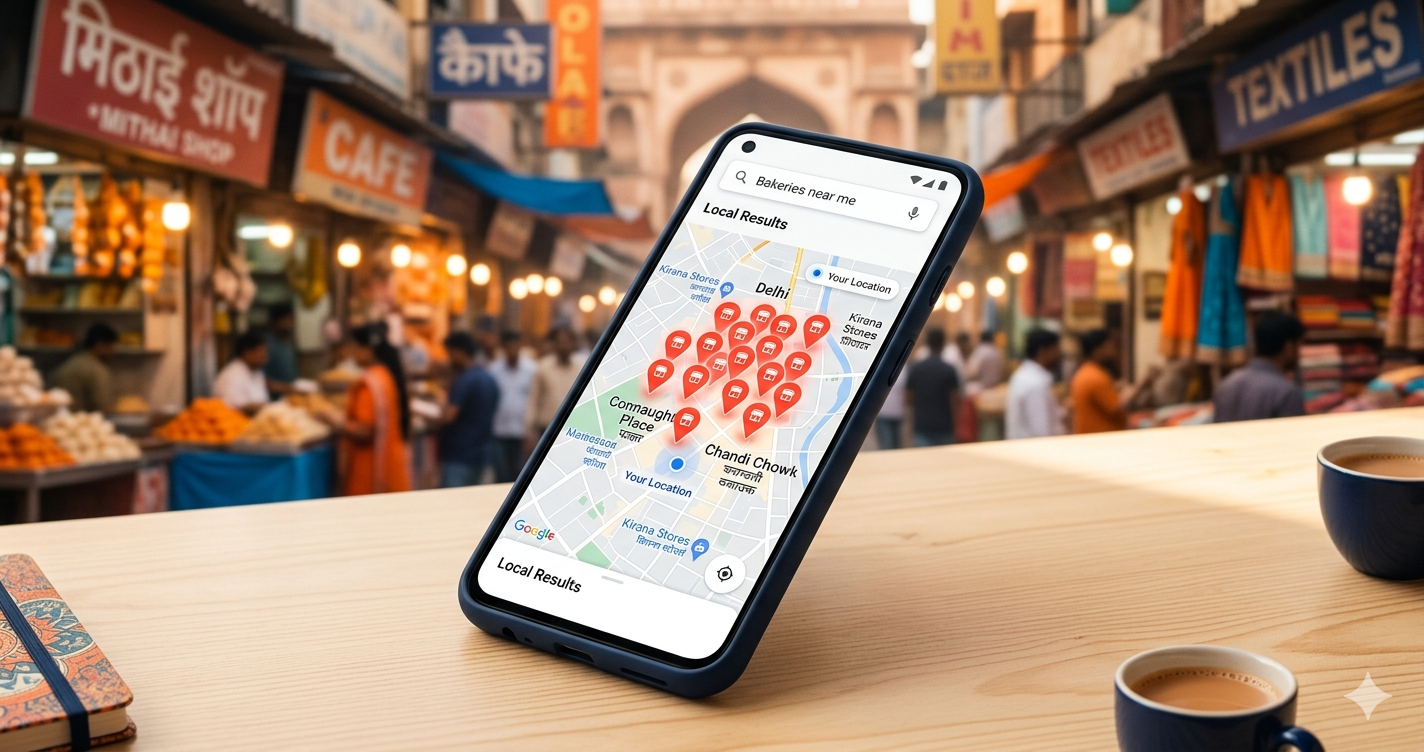
Imagine walking down a busy street anywhere in India looking for a specialty coffee roaster. What is the first thing you do? You pull out your phone, open your map app, and type a quick phrase. Within seconds, a handful of hyper-local options pop up with ratings, opening hours, and directions.

This everyday behavior shapes how modern commerce functions across the country. Modern consumers rarely scroll through pages of blue links anymore; instead, they look for fast, hyper-localized results that answer their immediate needs on the go.

If your business is not visible in those exact micro-moments, you essentially do not exist to a massive pool of ready-to-buy consumers. Establishing a bulletproof strategy for local SEO in India has shifted from being a smart digital marketing experiment to a core survival requirement for neighborhood brands.

local seo in india

Why Businesses Fail Without Local SEO in India for Small Business

Many business owners spend significant budgets trying to rank for broad, nationwide keywords when their actual buyers live within a few kilometers of their location. This mismatch often results in wasted marketing spend, low-quality traffic, and poor conversion rates. While national visibility may seem attractive, most small businesses depend on local customers who are actively searching for nearby products and services.

Without a targeted local SEO for small business strategy, companies struggle to appear in relevant local searches. Even businesses with excellent products, competitive pricing, and strong customer service can lose potential customers if they are not visible when people search online. As a result, competitors with stronger local optimization often capture the majority of local demand.

The challenge is that consumer behavior has changed. Today, people search for solutions “near me” and expect immediate, location-specific results. Search engines prioritize proximity, relevance, and trust signals such as reviews, local citations, and accurate business information. Businesses that invest in local SEO gain better visibility, attract high-intent customers, and build a sustainable competitive advantage in their target market.

The Growing Importance of Local SEO in India

The way people discover local businesses in India has changed significantly in recent years. Instead of browsing directories or relying on word-of-mouth recommendations, consumers now turn to search engines to find nearby products and services. Whether someone is searching for a restaurant, clinic, salon, or repair service, search results are increasingly personalized based on location, intent, and relevance.

At the same time, search engines have become smarter. AI-powered search experiences analyze business listings, customer reviews, maps data, and website content to provide instant answers. This means businesses must ensure their local information is accurate, consistent, and easily accessible across digital platforms. Simply targeting keywords is no longer enough to maintain strong visibility in local search results.

This shift highlights the growing importance of local SEO in India. Businesses that optimize their online presence can attract more qualified local customers, improve trust, and increase conversions. Those that fail to establish a strong local footprint risk losing visibility to competitors who provide clearer location signals, stronger credibility, and a better overall user experience.

How Local Search Turns into a Customer

🔍
Search Query
📍
Google Maps / Local Results
👤
Business Profile Viewed

Reviews Checked
🌐
Website Visit / Call
🏪
Store Visit
💳
Purchase

The 4-Pillar Engine for Google Business Profile Optimization

Building a reliable regional presence requires a systematic approach to formatting and structuring your business data. This framework ensures that search engines can easily find, verify, and display your brand to nearby shoppers.

  • Establish Data Symmetry: Ensure your Name, Address, and Phone number are identical across your website, social media channels, and local directories. Even a tiny variation like writing “3rd Main Road” on one platform and “3rd Main” on another confuses search crawlers.
  • Execute Google Business Profile Optimization: Claim your profile, select the most accurate primary category, and upload high-resolution photos of your storefront regularly. Keep your operational hours updated, especially during regional holidays, to build trust with both users and algorithms.
  • Build Hyper-Local Citations: List your business on prominent Indian directories such as Justdial, Sulekha, and IndiaMART. Ensure that every single citation points back to the exact same address structure established in your initial setup phase.
  • Cultivate Consistent Review Velocity: Encourage satisfied customers to leave detailed reviews mentioning your specific services and location names. Respond swiftly to every review, thanking positive reviewers and offering polite solutions to any negative feedback.

The Concrete Benefits of Local SEO

Consumer search behavior has shifted dramatically across India’s tier-1, tier-2, and tier-3 cities. Today, customers rely on search engines to find nearby businesses, compare options, read reviews, and make purchasing decisions. This trend has made local visibility a critical factor in business growth.

The numbers highlight the impact. Nearly 46% of all Google searches have local intent, meaning users are actively looking for products or services in their area. Additionally, 76% of people who perform a local search on their smartphones visit a related business within a day, while 28% of those searches result in a purchase. These statistics demonstrate why local SEO is one of the highest-converting digital marketing strategies available to businesses.

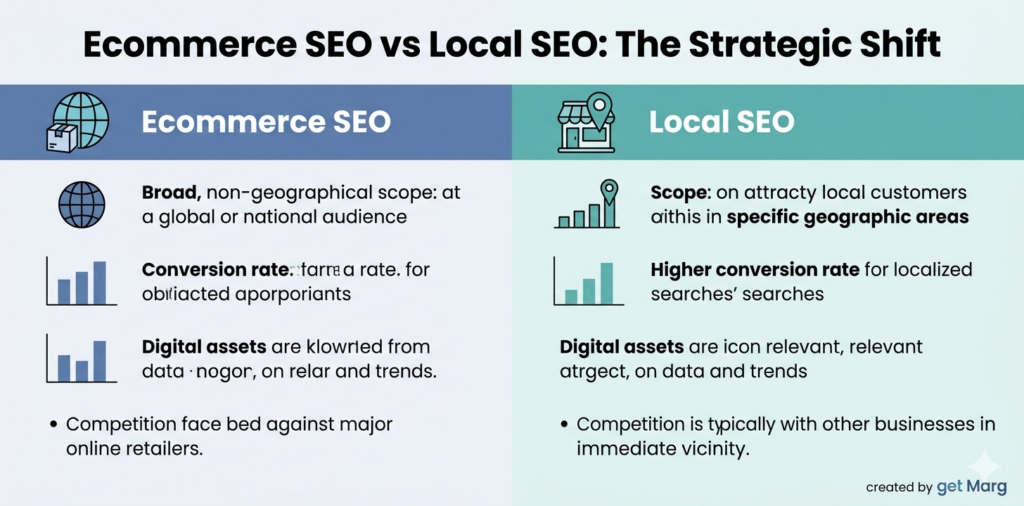
Ecommerce SEO vs Local SEO

Strategic AttributeEcommerce SEOLocal SEO
Geographic ScopeNational or international audiencesSpecific cities, regions, or neighborhoods
Primary GoalOnline sales and transactionsFoot traffic, calls, bookings, and local leads
Core AssetsProduct pages and category pagesGoogle Business Profile, citations, and local landing pages
Target KeywordsBroad, high-volume keywordsLocation-specific, high-intent keywords
CompetitionNational brands and marketplacesLocal and regional competitors

Understanding the difference between ecommerce SEO and local SEO is essential for allocating marketing resources effectively. While ecommerce SEO focuses on reaching a broad audience, local SEO targets customers who are actively searching for nearby solutions and are often closer to making a purchase decision. This targeted approach leads to higher conversion rates, stronger customer engagement, and sustainable business growth.

ecommerce vs local seo

Real-World Case Study: How Zomato Proved the Importance of Local SEO in India

One of the best examples of the importance of local SEO in India is Zomato. Before becoming a leading food delivery platform, Zomato built its reputation as a restaurant discovery platform that helped users find dining options in their immediate area.

The company understood that users searching for restaurants were not looking for generic information. They wanted highly specific details such as location, menu prices, customer reviews, ratings, photos, and nearby dining options. To meet this demand, Zomato created dedicated pages for cities, neighborhoods, and popular food hubs across India. This allowed the platform to rank for thousands of location-based searches related to restaurants and dining experiences.

For example, users searching for restaurants in areas such as Connaught Place in Delhi or Indiranagar in Bengaluru could find highly relevant pages tailored to those locations. By organizing content around local intent rather than broad national keywords, Zomato improved search visibility and user experience simultaneously.

The key lesson for businesses is clear. Customers often search for solutions within a specific locality, not an entire city or country. Creating location-specific content, maintaining accurate business information, and optimizing for local search intent can significantly improve visibility and attract more qualified customers.

Where Brands Fail in Local SEO for Small Business

Many businesses miss out on the full benefits of local SEO because they fall into predictable operational traps that damage their visibility.

  1. Ignoring Active Listings: Leaving your business profile unverified or neglecting to update your active phone numbers and holiday hours regularly.
  2. Creating Multiple Duplicate Listings: Setting up multiple map markers for a single physical storefront in an attempt to game the algorithm, which triggers automatic suspension.
  3. Neglecting Localized Website Copy: Failing to include regional landmarks, neighborhood names, and localized service descriptions within your website content.
  4. Siloing Digital Strategy: Treating physical store operations and online marketing as separate departments instead of building an integrated customer journey.
  5. Ignoring Bad Reviews: Leaving negative feedback unaddressed, which signals poor customer service to both prospective buyers and search algorithms.

Many of these mistakes seem minor individually, but their cumulative impact can significantly reduce local search visibility and customer engagement. Successful local SEO requires consistent business information, active reputation management, and a strong connection between your online presence and offline operations. Businesses that regularly audit their local profiles and prioritize customer experience are more likely to achieve sustainable growth in local search results.

Launching Your Local SEO in India Strategy

Building a strong local presence requires a consistent and structured approach. Rather than chasing broad keywords, businesses should focus on improving visibility within their target locations and ensuring customers can easily find accurate information online.

  • Conduct a local citation audit to identify and correct inconsistent business information across directories and listing platforms.
  • Optimize your website footer with your business name, complete address, local phone number, business hours, and service area details.
  • Create location-specific landing pages that address the needs, preferences, and search intent of customers in different cities or neighborhoods.
  • Encourage satisfied customers to leave reviews through QR codes, email follow-ups, or post-purchase messages.
  • Regularly update your Google Business Profile with new photos, posts, offers, and business information.
  • Use localized keywords naturally throughout your website content, metadata, and business listings.
  • Track key metrics such as local rankings, website traffic, calls, direction requests, and customer reviews to measure performance and identify improvement opportunities.

Local SEO is not a one-time task. Consistent optimization, accurate business information, and ongoing customer engagement are essential for maintaining visibility and attracting qualified local customers over the long term.

Essential Local SEO Insights

  • Proximity drives purchasing decisions– Modern consumers prefer businesses that are nearby and easy to access. A strong local SEO strategy helps your business appear when potential customers are actively searching for products or services in your area.
  • Consistent business information improves visibility– Maintaining accurate details such as your business name, address, phone number, and operating hours across directories helps search engines verify your legitimacy and improves local rankings.
  • Customer reviews influence both rankings and trust– Positive reviews not only strengthen your local search presence but also encourage potential customers to choose your business over competing options.
  • Local SEO and ecommerce SEO serve different goals– While ecommerce SEO focuses on reaching broad audiences and driving online sales, local SEO targets high-intent users who are looking for nearby solutions and are often ready to take immediate action.
  • Location-specific content creates long-term value– Dedicated pages for cities, neighborhoods, or service areas help establish topical authority, improve search visibility, and attract qualified local traffic over time.
  • Google Business Profile remains a critical asset– Regular updates, accurate information, fresh photos, and customer engagement can significantly improve your chances of appearing in local search results and map listings.
  • Local SEO is a long-term investment– Businesses that consistently optimize their local presence build stronger brand awareness, attract more qualified leads, and create a sustainable competitive advantage within their target markets.

Conclusion

The digital landscape is moving rapidly toward a world where search engines answer questions instantly based on where the user is standing. The convenience of finding a verified, highly-rated service provider next door has permanently shifted consumer expectations.

Investing time into targeted local strategies is no longer just an optional marketing tactic; it is a foundational asset that grows in value over time. Brands that take control of their geographical digital presence today will secure the best digital real estate in their markets for years to come.

As you look to scale your neighborhood footprint, having an experienced partner makes all the difference. At GET Marg, we specialize in helping brands navigate the complexities of modern search ecosystems, performance marketing, and digital growth. Partnering with GET Marg ensures your business stays visible, relevant, and chosen by the consumers who matter most to your bottom line.

Are You Ready To Get Searched?

Ready to turn nearby searches into paying customers? Navigating map algorithms, review velocity, and citation consistency can feel overwhelming when you are running a business. Let GET Marg handle the complexities of your digital footprint. As your modern growth partner, GET Marg aligns your brand with local search trends, AI visibility, performance marketing, and lead generation to ensure your storefront dominates your target neighborhood. Reach out to GET Marg today, and let’s build a sustainable local growth engine together.

Frequently Asked Questions(FAQs)

Q1. What is the primary difference when comparing ecommerce SEO vs local SEO?

Global e-commerce optimization targets high-volume, non-geographical keywords to drive traffic to an online storefront regardless of user location. Local optimization focuses purely on capturing search intent within a specific geographic boundary to drive physical store visits or direct local inquiries.

Q2. How long does it take to see the benefits of local SEO for my store?

Most businesses notice an uptick in map views and phone inquiries within 4 to 8 weeks after executing a thorough Google Business Profile optimization campaign and cleaning up inconsistent citations across web directories.

Q3. Can a business without a physical storefront practice local SEO for small business?

Yes, service-area businesses that deliver products or services directly to customers at their locations can set up profiles highlighting their specific operational radiuses without publicly displaying a residential home address.

Q4. Why is there a growing importance of local SEO in India for tier-2 and tier-3 cities?

With rapid smartphone adoption and localized internet penetration across India, consumers in tier-2 and tier-3 cities increasingly search for “near me” businesses to fulfill immediate service and retail needs locally.

Q5. How do customer reviews impact my local SEO in India rankings?

Review volume, velocity, and positive sentiment tell search algorithms that your business is active, trustworthy, and popular among real users, which directly pushes your profile higher in local search results.

Local SEO in India: Grow Your Footprint and Outrank Neighborhood Competitors Read More »

How to Optimize Google Business Profile

How to Optimize Google Business Profile: A Complete 2026 Guide for Better Local Search Visibility

Introduction: Why Google Business Profile Optimization Matters in 2026

For local businesses, being visible when customers search online is no longer optional. Today, people rely on Google Search, Google Maps, and AI-powered search experiences to discover nearby businesses, compare services, read reviews, and make buying decisions.

A properly optimized Google Business Profile (GBP) can help businesses appear in local search results, improve customer trust, increase website visits, and generate more calls or inquiries.

With the rise of AI search experiences like Google AI Overviews, local businesses now need more than basic profile creation. They need a complete strategy that combines Google Business Profile SEO, local SEO, and AI search optimization for local businesses.

This guide explains how to optimize Google Business Profile effectively, improve rankings, and increase AI-powered local search visibility.

What Is Google Business Profile Optimization?

Google Business Profile optimization is the process of improving your business listing on Google so that it appears more frequently in relevant local searches.

A well-optimized profile helps Google understand:

  • Who you are
  • What products or services you provide
  • Where you operate
  • Why customers should choose your business

Google Business Profile optimization includes updating business information, improving reviews, adding relevant content, optimizing categories, posting regularly, and maintaining accurate details.

For businesses targeting local customers, GBP is one of the most powerful tools for improving visibility on Google Maps and local search results.

Why Google Business Profile SEO Is Important for Businesses

A Google Business Profile works as a digital storefront for your business.

When optimized correctly, it helps you:

1. Increase Local Visibility

Customers searching for services near them often see Google Maps listings before visiting websites.

An optimized profile increases your chances of appearing in:

  • Google Maps results
  • Local search results
  • “Near me” searches
  • AI-generated search recommendations

2. Build Customer Trust

Customers use your GBP profile to check:

  • Reviews
  • Photos
  • Business information
  • Working hours
  • Services

A complete and updated profile creates confidence before a customer contacts you.

3. Generate More Leads

A strong profile encourages users to:

  • Call your business
  • Visit your website
  • Request directions
  • Send inquiries

For service-based businesses and SMBs, GBP can become a consistent lead generation channel.

Why Google Business Profile SEO Is Important for Businesses

Google Business Profile (GBP) SEO is essential because it directly improves local visibility, credibility, and customer engagement. It helps businesses in New Delhi and beyond show up in Google Search, Maps, and the “Local Pack” when customers look for nearby services. A well-optimized profile builds trust, drives foot traffic, and increases conversions.

When optimized correctly, it helps you:

  1. Boosts Local SEO
    • GBP ensures your business appears in Google Maps and the Local Pack (top 3 listings) for searches like “best café near me.”
    • Nearly 46% of Google searches are local. A strong profile connects you directly to nearby customers.
  2. Builds Credibility
    • Verified profiles show legitimacy.
    • Businesses with GBP are seen as 2.7 times more trustworthy than those without.
    • Positive reviews and regular updates encourage customers to choose you over competitors.
  3. Provides Insights
    • GBP provides analytics on profile views, website clicks, and direct calls.
    • These insights help improve your SEO and marketing strategies.
  4. Enhances Engagement
    • You can respond to reviews, post updates, share photos, and answer FAQs.
    • This interaction builds loyalty and improves customer satisfaction.

The Core Problem with Ignored Local Listings

The biggest issue most service-based business owners face is treating their local search presence like a static digital billboard. You might have your address and phone number listed, but a bare-bones setup will not help you improve local search ranking. Competitors who actively manage their digital storefronts will consistently outrank you and capture the exact leads you want.

When you fail to grasp how to optimize Google Business Profile, your digital presence suffers from several compounding problems. To truly improve local search rankings, you need to understand where your current setup falls short.

  • Incomplete Information: Missing business hours or service details frustrate potential customers.
  • Stagnant Visuals: Profiles with zero new photos look abandoned and untrustworthy.
  • Unanswered Reviews: Ignoring customer feedback signals poor customer service to both buyers and search engines.
  • Irrelevant Categories: Choosing the wrong primary business category confuses the search algorithm.
  • Zero Updates: Failing to post offers or updates makes your business look inactive compared to competitors.

The Shift Toward Intent-Driven Local Search

Search engines are getting incredibly smart at understanding exactly what a user wants. We are now seeing a massive shift toward AI search optimization for local businesses. The search engine no longer just matches keywords. It looks at user proximity, past behaviour, and how authoritative your listing appears.

This is where Google AI Overviews and local SEO begin to merge. AI summaries are starting to pull data directly from highly detailed business profiles to answer complex user queries. If you want your business recommended by these intelligent systems, your profile data must be rich, accurate, and frequently updated.

  1. Contextual Relevance: AI systems read your reviews and descriptions to understand exactly what you sell.
  2. Verification Signals: Consistent updates prove to the algorithm that your business is currently operational.
  3. Behavioral Metrics: The system tracks how many people click for directions or call your number.
  4. Trust Authority: A steady stream of positive reviews acts as a primary trust signal for AI recommendations.

The Framework: How to Optimize Google Business Profile

To master Google Maps SEO optimization, you need a systematic approach. The most successful agency owners and digital marketing professionals treat their local profiles as dynamic social platforms rather than static directories. Following core Google Business Profile best practices ensures your foundation is solid enough to build upon.

When you ask how to optimize Google Business Profile effectively, the answer lies in a four-pillar framework. At GET Marg, we frequently help brands implement these exact pillars to establish immediate local authority.

  • Pillar 1: Data Accuracy. Ensure your Name, Address, and Phone Number match exactly across your website, social media, and local listing.
  • Pillar 2: Visual Storytelling. Upload high-quality photos of your exterior, interior, products, and team members every single week.
  • Pillar 3: Reputation Management. Respond to every single review within 24 hours, whether it is positive or negative.
  • Pillar 4: Active Engagement. Use the Q&A feature and regular profile posts to keep your digital storefront active.

How to Optimize Google Business Profile Step-by-Step

1. Complete Your Business Information

The first step in any Google Business Profile setup guide is completing every section accurately. A complete profile gives Google detailed information about your business and helps customers find the right information before contacting you.

Start by logging into your Google Business Profile account and reviewing every available section. Do not leave important fields incomplete because missing information can reduce trust and affect your local search visibility.

Update the following details carefully:

  • Business name
  • Address
  • Phone number
  • Website URL
  • Business hours
  • Holiday hours
  • Service areas
  • Business description
  • Appointment links (if applicable)
  • Business attributes
  • Contact options

Business Name

Enter your official business name exactly as it appears in the real world. Avoid adding extra keywords, locations, or promotional words that are not part of your registered business name.

For example:

Correct:
“ABC Digital Solutions”

Incorrect:
“ABC Digital Solutions Best SEO Agency in Mumbai”

Using unnecessary keywords in your business name can violate Google guidelines and may negatively impact your profile.

Address and Service Area

Make sure your physical address is accurate and matches your website and other online listings.

If you serve customers at their locations instead of having a customer-facing office, configure your service area properly.

For example:

A home cleaning company can add areas like:

  • Mumbai
  • Thane
  • Navi Mumbai

This helps Google show your business to customers searching within those locations.

Phone Number and Website

Use a phone number that customers can easily reach. Avoid frequently changing contact details because consistency helps build trust.

Add your official website URL and ensure it directs users to a relevant page, such as:

  • Homepage
  • Service page
  • Location page
  • Booking page

Business Hours

Keep your working hours updated. Incorrect timings can create a poor customer experience.

Also update:

  • Weekend hours
  • Holiday closures
  • Special business timings

If customers visit your location and find it closed despite Google showing it as open, it can lead to negative reviews.

Business Description

Write a clear description explaining:

  • What your business offers
  • Who you serve
  • Your location
  • Your key advantages

Use natural keywords related to your services, but avoid stuffing keywords unnecessarily.

Maintain Information Consistency

Make sure your business details match across:

  • Website
  • Social media profiles
  • Online directories
  • Review platforms

Consistent information improves credibility and helps Google understand your business better.

2. Choose the Right Business Category

Selecting the correct primary category is one of the most important Google Business Profile best practices.

Your category tells Google what your business does and helps determine which searches your profile appears for.

Start by researching categories related to your business. Choose the category that most accurately represents your main service or product.

For example:

A restaurant should not choose only “food business” when a specific category like “Indian restaurant” is available.

Use:

  • One accurate primary category
  • Relevant secondary categories

Your primary category should represent your main offering.

Example:

A digital marketing agency may choose:

Primary category:
“Marketing agency”

Secondary categories:

  • Internet marketing service
  • Advertising agency
  • Web design service

Avoid selecting unrelated categories just to gain visibility. Incorrect categories can confuse Google and attract irrelevant traffic.

Review your categories regularly because Google updates available business categories over time.

3. Optimize Your Business Description

Your business description should naturally include relevant keywords while clearly explaining your value.

A strong description helps both customers and search engines understand your business.

Include:

  • Your main services
  • Location served
  • Target customers
  • Experience
  • Unique selling points
  • Business strengths

Example:

Instead of:

“Welcome to our company.”

Write:

“We help small businesses improve online visibility through digital marketing, local SEO, and Google Business Profile optimization.”

Keep your description customer-focused. Explain how your business solves problems instead of only listing services.

Avoid keyword stuffing. Repeating the same keywords multiple times can make your description look unnatural and may reduce trust.

4. Add High-Quality Photos and Videos

Visual content improves engagement and builds credibility.

Customers often check photos before deciding whether to contact a business.

Upload:

  • Business photos
  • Product images
  • Team photos
  • Office/store images
  • Before-and-after visuals
  • Customer experience photos
  • Service demonstration videos

Use clear, high-resolution images that represent your actual business.

For example:

A restaurant should upload:

  • Interior photos
  • Food images
  • Staff photos
  • Menu highlights

A service business should upload:

  • Team images
  • Work examples
  • Project results

Regular uploads show Google that your profile is active and maintained.

5. Collect and Manage Customer Reviews

Reviews are one of the strongest trust signals for local businesses.

A profile with positive, genuine reviews is more likely to attract customers and improve local visibility.

Encourage satisfied customers to leave feedback by:

  • Sending review links after successful service
  • Asking customers personally
  • Adding review requests in follow-up messages

Best practices:

  • Respond to every review
  • Thank customers for positive feedback
  • Address negative feedback professionally
  • Add relevant keywords naturally in responses

Example:

“Thank you for choosing us for your website development project. We appreciate your trust in our digital solutions.”

Avoid copying the same response for every review. Personalized replies create better engagement.

6. Use Google Posts Regularly

Google Posts help keep your profile fresh and provide customers with updated information.

You can share:

  • Offers
  • New services
  • Updates
  • Events
  • Customer stories
  • Product launches
  • Announcements

Create posts that encourage action.

Examples:

  • “Book your free consultation today”
  • “Explore our latest service package”
  • “Get 20% off this month”

Use images, clear descriptions, and call-to-action buttons whenever possible.

Regular posting improves customer engagement and supports local visibility.

7. Add Products and Services

Adding services helps Google understand your offerings and improves your chances of appearing for specific searches.

Create detailed service listings with:

  • Service names
  • Descriptions
  • Pricing (if applicable)
  • Relevant details

For example:

Instead of adding:

“SEO”

Add:

“Local SEO Services for Small Businesses”

A detailed service description helps Google match your profile with relevant customer searches.

Review your services regularly and update them whenever your business introduces new offerings.

8. Optimize for Google Maps SEO

Google Maps SEO optimization focuses on improving your visibility when users search locally.

A strong Maps presence helps nearby customers discover your business and take action.

Key actions:

  • Keep business information updated
  • Add location-specific keywords naturally
  • Collect quality customer reviews
  • Upload fresh photos regularly
  • Maintain active profile engagement
  • Add accurate service information
  • Build local authority through online mentions

Also ensure your website supports your Google Maps strategy by including:

  • Location pages
  • Local keywords
  • Contact details
  • Service information

A well-optimized Google Business Profile combined with strong local SEO helps convert nearby searches into calls, visits, and inquiries.

9. Enable Messaging on Google Business Profile

Enabling messaging on your Google Business Profile allows potential customers to contact you directly from Google Search and Google Maps.

This feature helps businesses respond quickly to customer questions and improve engagement.

To make the most of GBP messaging:

  • Turn on chat functionality in your profile
  • Set up notifications so you do not miss inquiries
  • Respond as quickly as possible
  • Provide helpful answers about services, pricing, and availability

Fast responses improve customer experience and can increase the chances of converting searches into leads.

For service-based businesses, messaging creates an additional communication channel that makes it easier for customers to take the next step.

10. Track Performance with Insights

Optimizing your Google Business Profile is not complete without monitoring performance.

Google Business Profile Insights helps you understand how customers discover and interact with your listing.

Track important metrics such as:

  • Search queries used to find your business
  • Profile views
  • Website clicks
  • Phone calls
  • Direction requests
  • Message interactions
  • Customer actions

Use these insights to identify what is working and where improvements are needed.

For example:

If customers are finding your profile through specific services, you can create more content around those offerings.

Regular performance tracking helps you improve your Google Business Profile SEO strategy and make data-driven decisions for better local search visibility.

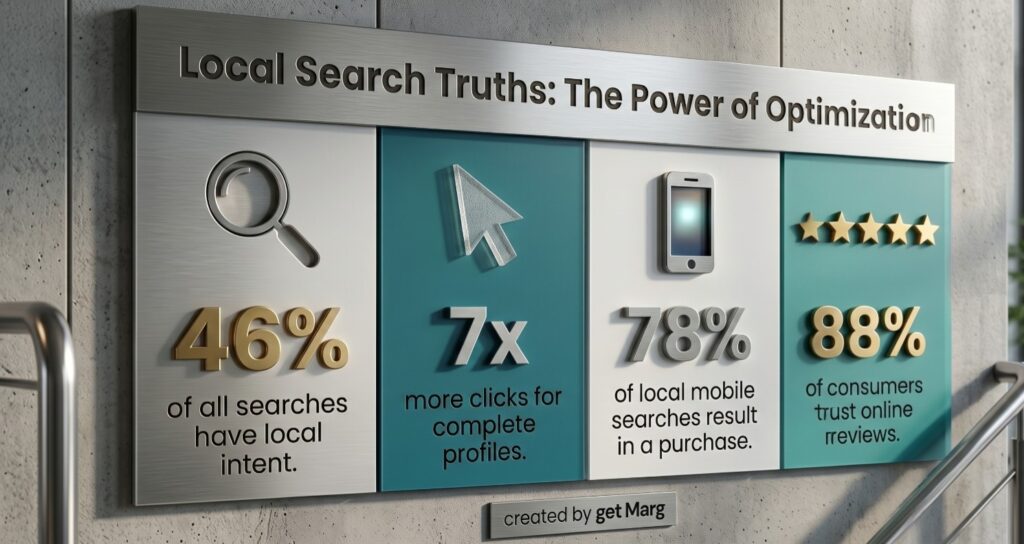
Local Search Truths and Data

Understanding the data behind local search behavior makes it clear why these efforts matter so much. When you want to improve local search ranking, you must look closely at how users actually behave on their mobile devices. You cannot ignore the mathematics of local digital discovery.

The numbers reveal exactly how consumer habits are shaping the future of retail and service industries. Here are the core statistics you need to know about local search behavior right now.

Consumer Behavior MetricBusiness Impact
Around 46% of all searches have local intentNearly half of all search traffic is looking for a nearby solution
Complete profiles receive 7x more clicksFilling out every field drastically improves your search visibility
About 78% of local mobile searches end in an offline purchaseHigh-intent mobile users convert at an incredible rate
Nearly 88% of consumers trust online reviewsDigital reputation carries the exact same weight as personal recommendations

How Zomato Mastered Google Maps SEO optimization

Let us look at a real-world example of exceptional digital growth and local dominance. Zomato did not just rely on a well-designed app to attract hungry customers. As they expanded across Indian cities, they executed a masterclass in local discovery and Google Maps SEO optimization.

They treated neighborhood searches as highly unique digital entities. By focusing heavily on localized content, they ensured every specific search query led right to their partner restaurants.

  • They optimized local listings with high-intent keywords like “best butter chicken in Delhi” to capture specific neighborhood intent perfectly.
  • They utilized Google Maps SEO optimization to ensure partner restaurants ranked highly in the highly coveted local pack.
  • Their team ensured that menus, operating hours, and photos were constantly updated to signal freshness to the search algorithm.
  • They built an ecosystem where reviews and user photos naturally kept the listings active without manual intervention.

Common Mistakes Hurting Your Google Business Profile ranking factors

Many businesses try to grow but end up hurting their own visibility through outdated and risky tactics. The most common error is keyword stuffing the official business name. If your legal name is Sharma Plumbers, do not list it as Sharma Plumbers Best Cheap Service in Delhi.

Another major failure point is neglecting Google AI Overviews and local SEO entirely. When you do not provide rich answers in your Q&A section, AI systems simply skip over your business. To protect your presence, avoid these frequent errors.

  1. Leaving bad feedback unanswered shows future customers you do not care about resolving genuine issues.
  2. Using generic stock photos instead of real images of your actual business environment destroys trust instantly.
  3. Having a different phone number on your website versus your local profile confuses both the algorithm and the customer.
  4. Ignoring AI search optimization for local businesses by leaving your specific service descriptions completely blank.
  5. Failing to understand how to optimize Google Business Profile by never posting updates or newly launched products.

How GetMARG Helps Businesses Improve Online Visibility

At GetMARG, we understand that modern businesses need visibility across traditional search and AI-driven platforms.

Our approach focuses on helping businesses improve:

  • Local search presence
  • Online discoverability
  • Brand authority
  • Customer trust
  • Digital visibility

With changing search behavior, businesses need strategies that go beyond basic listings and focus on long-term online growth.

Conclusion

In order to increase local visibility and build trust with customers by utilizing a Google Business Profile and growing your authority to obtain quality leads, you will need to maximize the optimization of your Google Business Profile. When a business has a complete and up-to-date Google Business Profile it can be used for both of these strategies through increased ranking in the local search engine as well as for the use of artificial intelligence (AI) to find them on services such as Google Maps.

To improve your Google Business Profile (GBP) search engine optimization (SEO), businesses should emphasize providing customers with accurate business information, requesting customer reviews, listing the pertinent services that you offer, and responding to inquiries to build credibility.

Businesses will need to adapt as the digital search experience changes because AI is developing new methods for improving the digital search process. Companies that have an established GBP will become easier to find, will have increased credibility, and will use local search to drive revenue. Google’s Business Profile optimization is an important investment in developing your online presence for the continued success of your business.

Frequently Asked Questions (FAQ’s)

What is Google Business Profile optimization?

Google Business Profile optimization is the process of improving your business listing on Google to increase visibility in local search results. It includes updating business information, adding photos, managing reviews, optimizing categories, and keeping your profile active.

How does Google Business Profile help small businesses?

A well-optimized Google Business Profile helps small businesses appear in Google Search and Google Maps, attract local customers, build credibility, increase website visits, and generate more calls or inquiries.

What are the main Google Business Profile ranking factors?

The key Google Business Profile ranking factors include relevance, distance, and prominence. Google also considers profile completeness, reviews, customer engagement, business information accuracy, and online reputation.

How can I improve my Google Business Profile ranking?

You can improve your ranking by choosing the right business category, adding accurate details, collecting genuine reviews, posting regularly, uploading quality photos, adding services, and maintaining consistent business information online.

How often should I update my Google Business Profile?

Businesses should regularly update their profile by adding new posts, photos, offers, services, and responding to reviews. Frequent updates show Google that the business is active and relevant for customers.

How to Optimize Google Business Profile: A Complete 2026 Guide for Better Local Search Visibility Read More »

Digital Advertising in India

Digital Advertising Trends in India: How Small Businesses Can Grow Online

Learning about the latest Digital Advertising Trends in India is the best way for a small business to find new customers online today. The internet in India is growing faster than ever before. Millions of people in small towns and villages are buying smartphones and using high-speed mobile data for the first time. If you want your shop or local business to succeed, you cannot just wait for people to walk past your door; you need to show up on their phone screens.

Modern online marketing is no longer just for giant companies with huge bank accounts. Today, smart software tools make it easy for small businesses to show ads directly to people who are actively looking to buy their products. As search engines change to show quick answers directly on the screen, your online ads need to be simple, fast, and exciting enough to make a viewer stop scrolling and click.

The Big Problem: Why Old Marketing Ways Are Failing Local Indian Businesses

Many local business owners still spend a lot of money on printed flyers, local newspaper ads, or big roadside banners. While these old methods worked well in the past, they are losing their power because people’s attention has moved entirely to their mobile phones. When you print a flyer, you cannot choose exactly who sees it, meaning you waste a lot of money showing your business to people who do not care about your services.

This issue becomes very clear when we look at how fast the digital space is changing across the country. Relying on old-fashioned advertising means you are missing out on the exact people who are looking for your shop online right now. Local businesses that do not switch to online platforms are losing their regular buyers to nearby competitors who are actively placing ads on social media and maps.

The Huge Shift: How Mobile Phones and Local Languages Changed the Internet

The way Indian families use the internet has completely transformed over the last few years. Instead of reading websites in English on a desktop computer, most people now watch videos in their own local language on a smartphone. Families in smaller cities are using their voice to search for shops, and they expect to see videos and text in Hindi, Tamil, Telugu, Marathi, or Bengali.

Online PlatformWho Uses It MostBest Type of Ad to Use
Mobile Video AppsYoung people in small townsShort 30-second entertaining videos
Smart TV ApplicationsFamilies living in big citiesHigh-quality non-skippable video clips
Local Language WebsitesMulti-generational regional readersSimple picture ads with local language text
WhatsApp BusinessBusy daily shoppersDirect chat messages with quick payment links

Because of this massive shift, small businesses must change how they talk to their audience. If your online ads are only written in English, you are ignoring a huge group of buyers who prefer their native language. To stay ahead, your business needs to match these changes by creating simple, multi-lingual ads that feel natural and friendly to local shoppers.

The Simple Growth Framework: Navigating Modern Digital Advertising Trends in India

To build a strong online presence without wasting your hard-earned money, you need a clear and simple plan. The Simple Growth Framework is an easy four-step model designed to help any small business run successful online campaigns.

  • Local Language Setup: Write your ad text and headlines in the local language of your neighborhood to build quick trust with shoppers.
  • Automated Budget Control: Use built-in platform settings to automatically adjust your ad spend so you only pay when interested people click.
  • Smart Timing Rules: Set your ads to appear only during the hours your shop is open or when people are most likely to order.
  • Helpful Contact Buttons: Always add a direct link to your WhatsApp or phone line so customers can message your business instantly.

By following these four basic rules, your local business can create a safe and steady marketing system. This simple framework keeps your ad spend low while ensuring your messages reach the right neighborhood buyers. Working with a dedicated digital growth team like GET Marg helps you set up these automated steps perfectly, ensuring your small business gets maximum value from every single rupee spent.

Important Numbers: The Rapid Growth of Online Advertisements in India

If we look at the official market data, we can see that Indian businesses are moving their money into online ads at a record pace. More shops are shifting their budgets away from paper flyers to fund mobile-first internet ads. This trend is helping small retailers compete directly with massive brands on an equal playing field.

The Local Business Growth Journey

Phase 1

Traditional Marketing

Flyers, banners, local referrals and walk-in traffic.

Phase 2

Digital Presence

Facebook posts, WhatsApp sharing and basic online visibility.

Phase 3

Demand Generation

Local-language video ads that create awareness and inquiries.

Phase 4

Automated Growth Engine

Consistent lead generation, follow-ups and customer retention.

The data shows that local shops get much better results when they switch from old manual marketing to modern automated ad platforms. Businesses that use localized target settings enjoy higher sales and lower total advertising costs.

Marketing MetricOld Paper Marketing BaselineModern Automated Online AdsReal Improvement
Cost to Reach 1,000 PeopleINR 500INR 12076% Cheaper
Customer Response Rate1% or less5% to 8%Over 500% Higher
Actual Sales per CampaignLow and untrackableHigh and easily countedClear Revenue Lift

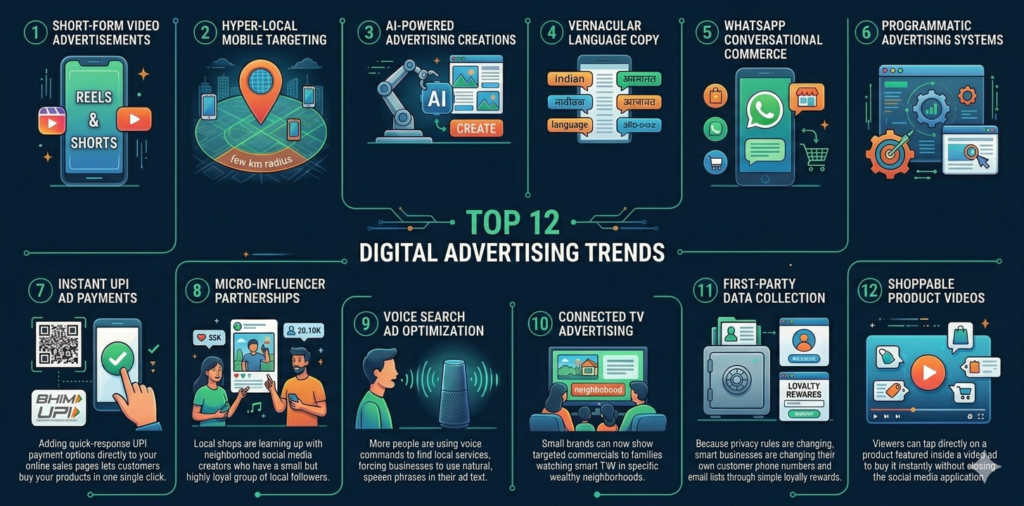
Top 12 Digital Advertising Trends Changing the Market Today

Top 12 Digital Advertising Trends
  • Short-Form Video Advertisements: Short, 30-second vertical videos on apps like Instagram Reels and YouTube Shorts are the number one way to grab attention today.
  • Hyper-Local Mobile Targeting: Small businesses can now choose to show their ads only to people standing within a few kilometers of their physical shop storefront.
  • AI-Powered Advertising Creations: Smart artificial intelligence tools can automatically create dozens of different image and text layouts for your ads in seconds.
  • Vernacular Language Copy: Online ads written in regional Indian languages are performing much better than ads written purely in English.
  • WhatsApp Conversational Commerce: Shoppers can now browse product catalogs, chat with business owners, and buy items inside a single WhatsApp chat thread.
  • Programmatic Advertising Systems: Automated computer programs handle your ad bidding, making sure your ads are placed on the best websites at the lowest possible price.
  • Instant UPI Ad Payments: Adding quick-response UPI payment options directly to your online sales pages lets customers buy your products in one single click.
  • Micro-Influencer Partnerships: Local shops are teaming up with neighborhood social media creators who have a small but highly loyal group of local followers.
  • Voice Search Ad Optimization: More people are using voice commands to find local services, forcing businesses to use natural, spoken phrases in their ad text.
  • Connected TV Advertising: Small brands can now show targeted commercials to families watching smart TVs in specific wealthy neighborhoods.
  • First-Party Data Collection: Because privacy rules are changing, smart businesses are collecting their own customer phone numbers and email lists through simple loyalty rewards.
  • Shoppable Product Videos: Viewers can tap directly on a product featured inside a video ad to buy it instantly without closing the social media application.

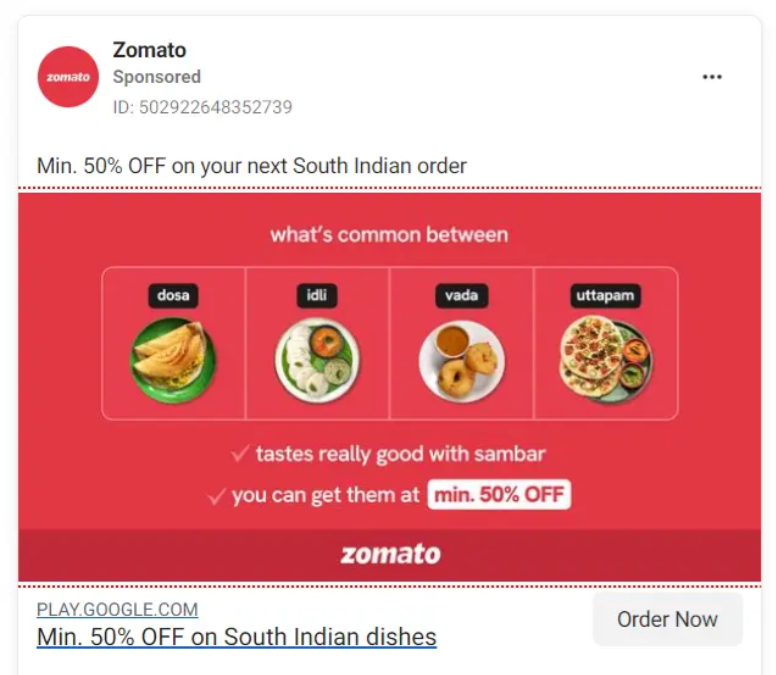
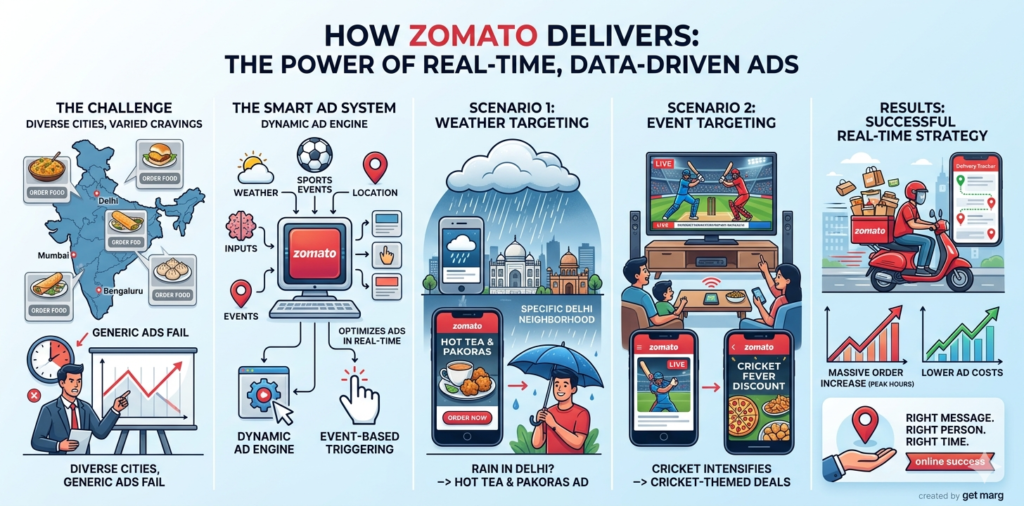
Real-World Case Study: How Zomato Uses Smart Online Ads to Match Customer Cravings

When we look at how successful Indian brands use modern technology, food delivery giant Zomato offers a perfect example. Zomato operates in hundreds of cities across India. In the beginning, they faced a difficult problem: people in different cities crave different foods at different times of the day, and a single, nationwide generic ad simply could not convince people to order food online.

To solve this, Zomato built a smart ad system that changes its messages automatically based on real-world events. If it starts raining heavily in a specific neighborhood in Delhi, their ad system automatically changes to show pictures of hot tea and pakoras to users in that exact area. During major cricket matches, their systems serve fun, cricket-themed discount ads right when the game becomes intense and viewers get hungry.

The results of this real-time ad strategy have been incredibly successful. Zomato saw a massive increase in food orders during peak lunch and dinner hours while keeping their ad costs very low. This proves that even for a massive company, online success comes down to showing the right message to the right person at the exact moment they want to buy.

Zomato Uses Smart Online Ads to Match Customer Cravings

Big Mistakes to Avoid: Old Habits That Waste Your Marketing Budget

  • Using Only English Text: Writing your ads exclusively in English means you are ignoring the massive population that prefers reading in their local language.
  • Leaving Ads Running Forever: Forgetting to refresh your ad pictures and videos causes viewers to get bored, which makes your advertising costs go up.
  • Setting Too Broad of a Location: Showing your neighborhood bakery ads to an entire state wastes your budget on people who live too far away to ever visit your shop.
  • Having a Slow-Loading Website: If your online landing page takes longer than two seconds to load on a mobile phone, customers will get frustrated and close it immediately.
  • Ignoring Customer Messages: Setting up online ads but failing to reply to the WhatsApp messages or comments left by interested buyers destroys customer trust.

Step-by-Step Guide: How to Start Your First Modern Online Ad Campaign

Phase 1: Figure Out Your Perfect Local Customer Group

Start by looking closely at who your best everyday customers are in the real world. Note down their average age, the languages they speak at home, and the specific problems they want your business to solve. Focus your advertising limits to target just those specific traits, ensuring your online budget is saved for people who fit your perfect buyer profile.

Before Launching Any Local Ad Campaign

01

Identify Real Customers

Focus on people who actually buy, not everyone who sees the ad.

02

Understand Language Preferences

Match creative messaging to the language customers naturally use.

03

Set Precise Local Targeting

Limit delivery to the geography that can realistically convert.

Phase 2: Create a Simple, Eye-Catching Video Ad

Use a smartphone to record a clean, 30-second vertical video showing your products, your team, or a quick behind-the-scenes look at your workshop. Keep the video honest and natural, as everyday consumers prefer authentic clips over overly polished corporate commercials. Write a short, friendly description in the local language of your town and add a big, clear instruction telling viewers what to do next.

Phase 3: Launch Your Campaign Using Small Daily Budgets

Open your chosen social media ad dashboard and create a new local awareness campaign. Set your daily spending limit to a small, comfortable amount, like INR 100 or INR 200 per day, so you can test the system safely.

Local Video Ad Launch Blueprint

Step 01

Set a Small Daily Budget

Start with a manageable budget and validate demand before scaling.

Step 02

Select Your Neighborhood

Target only the local area where customers can realistically visit or buy.

Step 03

Upload a Local Video Ad

Use local language, familiar locations, and clear customer benefits.

Step 04

Track Clicks Weekly

Measure performance consistently and refine targeting based on results.

Choose your exact neighborhood coordinates on the built-in map tool and let the platform start showing your ad to nearby mobile users.

Phase 4: Track Your Weekly Results and Reply to Inquiries

Check your ad account dashboard once every weekend to see how many people clicked your ad and sent a message. Look closely at which images or text styles brought in the most customer inquiries, and pause any ad variations that are costing too much money. Always reply politely to every single comment and direct message within a few minutes to convert casual online viewers into paying retail customers.

Key Takeaways for Small and Medium Businesses

  • Use local languages in your ad text to build fast trust with shoppers in your town.
  • Switch to short-form mobile videos to capture attention quickly and cheaply.
  • Set narrow geographic boundaries so your ads only show to people near your shop.
  • Link your advertising directly to your WhatsApp Business app to get fast sales inquiries.
  • Test your campaigns with very small daily budget limits to keep your marketing safe.
  • Keep your website fast and easy to use on mobile screens to stop users from leaving.

Navigating the Future of Digital Authority with GET Marg

As the online marketplace moves toward automated bidding systems, local video shopping, and fast mobile chat apps, old marketing tricks like paper flyers are no longer enough to grow a business. Local shop owners must adopt these modern digital advertising trends in India to protect their customer base and beat out larger, well-funded brands. Keeping up with these fast technical changes is much easier when you have a knowledgeable guide helping you manage the process.

GET Marg works as a dedicated, friendly digital growth partner for small and medium businesses that want to succeed across India’s competitive online channels. Our team sets up easy-to-use, highly effective marketing setups that include simple video strategies, local language ad writing, automated target selection, and smart social media campaigns. Partner with GET Marg to simplify your online advertising, maximize your local sales, and turn modern internet tools into steady, long-term business growth.

Frequently Asked Questions (FAQ’s)

Do I need a massive marketing budget to start running online ads?

No, you do not need a lot of money to begin. Most modern online ad platforms let you start your campaigns with as little as INR 100 per day. This low entry cost allows any local shop owner to test out different ideas safely and scale up their spending only after they see clear sales results.

What is AI-powered advertising, and how does it help a small business owner?

AI-powered advertising simply means using smart online software that automates the difficult parts of marketing. These tools help small business owners by automatically adjusting ad bids, finding the right target audience, and creating different ad layouts without needing a professional designer.

Why are local languages so important for online success in India today?

Local languages are critical because the vast majority of new internet users in India feel much more comfortable reading and watching videos in their native dialects. Using vernacular text helps your business stand out from generic English ads and creates an instant, friendly connection with local buyers.

How do I stop wasting money on people who live too far away from my shop?

You can easily stop budget waste by using geographic target rings inside your ad setup dashboard. This feature allows you to drop a digital pin directly on your shop’s address and set your ads to show only to mobile phone users standing within a specific radius, like three to five kilometers around your storefront.

Can I run a successful online ad campaign if I do not have a company website?

Yes, you can run highly successful campaigns without a website by using chat-first ad styles. You can design your ads to open a direct WhatsApp chat window or a standard phone call line the moment a user taps your image, allowing you to close sales through simple text conversations.

How does WhatsApp help businesses with digital advertising?

WhatsApp enables businesses to engage customers through personalized conversations, lead nurturing, product recommendations, appointment bookings, and customer support, often improving conversion rates.

What role do creators play in modern digital advertising?

Creators help brands build trust and authenticity with niche audiences. Their content often generates higher engagement and stronger purchase intent compared to traditional advertising formats.

How can small businesses benefit from digital advertising trends in India?

Small businesses can leverage AI tools, short-form video, local language content, creator partnerships, and WhatsApp marketing to reach targeted audiences, improve engagement, and achieve cost-effective growth.

Digital Advertising Trends in India: How Small Businesses Can Grow Online Read More »

luxury brand marketing psychology

Luxury Brand Marketing Psychology: Decoding Premium Consumer Behavior

The way people buy has changed dramatically over the last few years. Today, consumers do not just search for products; they ask AI engines for recommendations, research brand origins, and seek out deep alignment with their personal values. When it comes to high-end purchases, this shift is even more pronounced. Understanding luxury brand marketing psychology is no longer just about creating an aura of exclusivity. It is about understanding how human identity intersects with modern commerce.

For premium brands, fashion founders, and high-end service providers, survival relies on moving past standard transactional marketing. The modern audience can spot generic positioning instantly. To build real resonance, you have to understand the deeper emotional layers that make a premium price point feel not just justifiable, but necessary.

The Invisible Barrier: Why Standard Marketing Fails for Premium Brands

Most marketing advice focuses on solving functional problems quickly. This creates a massive issue for high-end businesses. When you sell a premium product or service, you are rarely competing on utility. A standard watch tells time just as well as a five-figure Swiss timepiece.

The core problem is that traditional marketing models optimize for volume, speed, and discounts. Applying these retail-level strategies to a high-end brand dilutes its perceived value.

The Disconnect in High Ticket Positioning

  • Traditional Marketing: Focuses on features, logical savings, and immediate affordability.

  • Premium Marketing: Focuses on heritage, identity transformation, and symbolic value.

  • The Result of Confusion: When a premium brand uses mass-market tactics, it creates cognitive dissonance for the buyer, leading to lost trust and dropped conversions.

The Shift in Premium Consumer Behavior

The digital landscape has fundamentally altered how people interact with high-end businesses. In an era dominated by conversational search and AI-driven recommendations, traditional gatekeeping is gone. Consumers have instant access to brand histories, manufacturing ethics, and community sentiment.

Modern luxury brand marketing psychology requires a deep understanding of information gain. When someone looks for premium services or goods, they want deep, authoritative insights that cannot be generated by a basic prompt. This shift means premium consumer behavior is guided by a search for authenticity and digital substance.

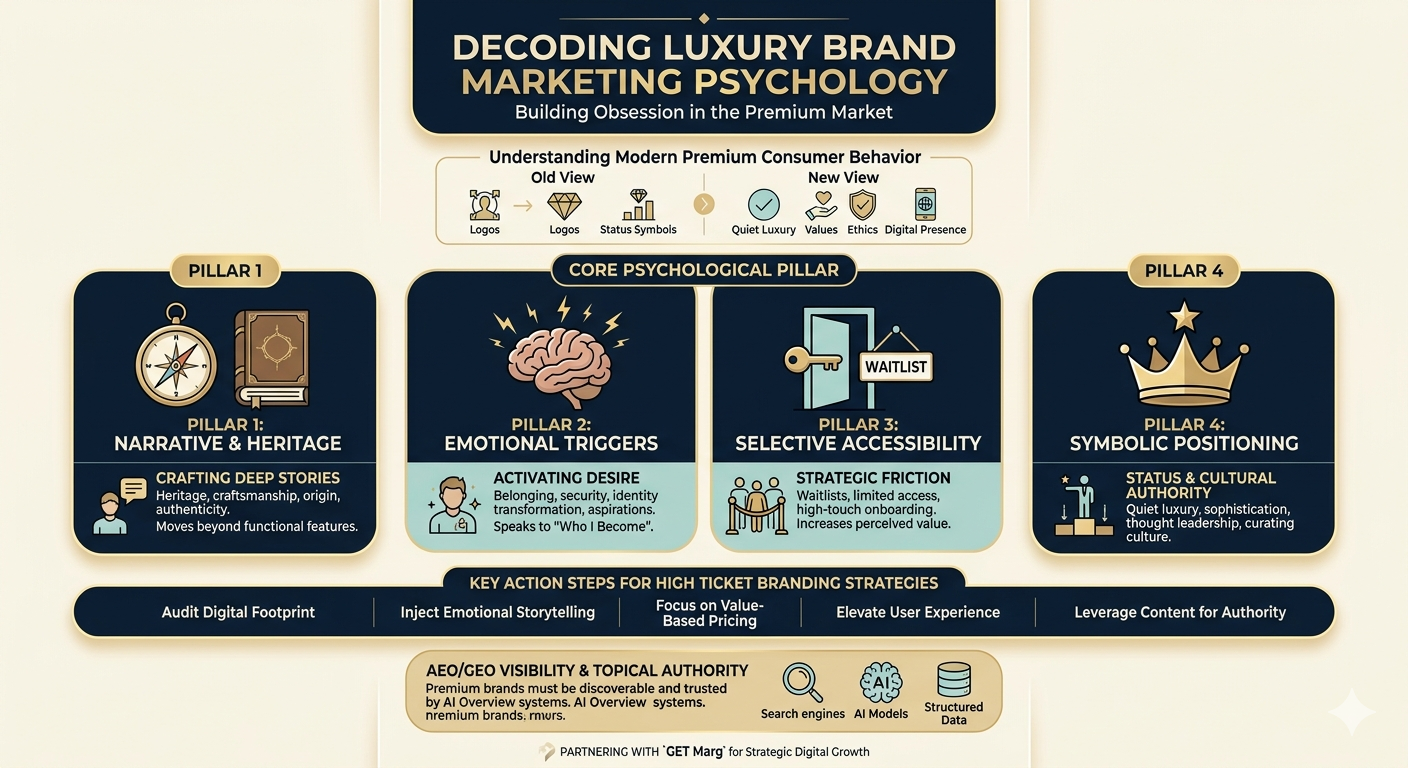
The Four Pillars of Luxury Brand Marketing Psychology

To build a brand that commands premium pricing, you must structure your positioning around specific emotional buying triggers. This framework moves your business away from commoditization and toward true industry authority.

1. The Paradox of Scarcity

Scarcity is not just about limited stock. In digital ecosystems, it means scarcity of access, time, or specific expertise. High ticket branding strategies leverage this by making the buying journey intentional rather than impulsive.

2. Identity and Social Signaling

Every premium purchase is a reflection of the buyer’s internal identity or desired social positioning. Your marketing must speak directly to who the buyer becomes when they associate with your brand.

3. The Power of High-Friction Onboarding

While mass-market brands try to remove every click from the checkout process, premium brands often introduce deliberate friction. Application processes, private consultations, and waitlists increase perceived value and filter for high-intent clients.

At GET Marg, our content strategy frameworks focus heavily on this element, ensuring that digital content qualifies premium buyers before they ever jump on a consultation call.

4. Cultural Authority and Narrative

A luxury brand must act as a cultural curator. This means your content should not merely describe your service or product; it must comment on industry trends, philosophy, and craft.

Data and Trends Shaping High-End Commerce

Recent shifts in digital search and consumer habits highlight how high-end buyers make decisions. The focus has moved away from flashy logos toward quiet sophistication and deep expertise.

Consumer Behavior TrendImpact on Premium BrandsStrategic Requirement
Search for Quiet LuxuryDecreased reliance on large visible branding.Focus on subtle, high-quality content and design.
AI-Driven ResearchShoppers use AI to compare brand sustainability and heritage.Build deep, clear digital footprints and topical authority.
Experience Over AssetHigher spending on premium services and exclusive access.Wrap physical products in high-touch digital experiences.

Real-World Applications: From Logic to Emotion

To see luxury brand marketing psychology in action, let us look at two contrasting approaches to positioning a high-end service business.

Scenario A: The Feature-Driven Firm

A boutique design agency positions itself by listing its technical capabilities. Their website focuses on turnaround times, software proficiencies, and competitive pricing structures. They struggle to justify a premium retainer because they are competing on functional metrics.

Scenario B: The Identity-Driven Partner

Another agency uses high ticket branding strategies to frame their work as a corporate legacy transformation. They produce deep-dive thought leadership on the evolution of brand aesthetics. They do not publish prices or offer discounts. Instead, they require a multi-step application.

They command five times the fee of Scenario A because they align with the client’s emotional buying triggers of status, security, and elite execution.

The Mistakes That Subtly Damage Premium Authority

Many premium brands inadvertently lower their market value by falling back on outdated digital marketing practices. Avoiding these missteps is critical to maintaining a luxury brand marketing psychology that works.

What Premium Brands Often Do Wrong

  • Offering frequent or predictable promotional discounts.

  • Over-explaining or over-justifying the price point in public copy.

  • Using aggressive, high-pressure sales countdown timers on websites.

  • Neglecting digital search visibility, assuming luxury means being entirely invisible.

What to Do Instead

Instead of discounting, increase the value of the experience by adding exclusive bonuses. Let your craftsmanship and client case studies justify your pricing naturally. Keep your website presentation clean, confident, and free of artificial urgency tactics. Ensure your digital footprint is discoverable by AI engines and search platforms without compromising your brand dignity.

Practical Action Steps for Premium Positioning

If you want to realign your brand with modern premium consumer behavior, you can implement these strategic changes immediately.

  1. Audit Your Digital Footprint: Look at your website and social channels through the lens of a high-intent buyer. Remove any copy that sounds defensive or transactional.

  2. Deepen Your Information Value: Produce content that offers genuine information gain. Write about your philosophy, your proprietary methods, or detailed industry analysis.

  3. Elevate Your Digital Touchpoints: Ensure your website design, loading speed, and initial inquiry process reflect the premium nature of your actual product or service.

  4. Refine Your Messaging Style: Transition your messaging from benefit-driven to identity-driven, speaking directly to the aspirational goals of your target audience.


Key Takeaways

  • Identity First: Luxury brand marketing psychology relies on selling an identity transformation, not just a functional tool.

  • Embrace Friction: Introducing intentional steps in the buying process builds anticipation and protects your brand equity.

  • Prioritize Digital Authority: Modern high-end consumers use AI and advanced search to vet brands; your digital presence must show deep topical expertise.

  • Control the Narrative: Avoid mass-market promotional tactics that dilute your perceived value and break consumer trust.

Does scarcity still work in digital marketing?

Real scarcity works exceptionally well. Digital brands can create scarcity through limited cohort availability, exclusive digital memberships, or time-bound access to specific high-end services, provided the scarcity feels authentic.

Elevating Your Brand Narrative

Building a premium brand requires a delicate balance of confidence, deep psychology, and modern visibility. When your digital presence perfectly aligns with the expectations of high-end buyers, pricing objections tend to disappear. The goal is to make your business the clear, authoritative choice for those who value absolute quality over the lowest price.

Partner With Us for Premium Growth

Navigating the complexities of luxury brand marketing psychology requires a partner who understands both the art of storytelling and the mechanics of modern digital platforms. At GET Marg, we help premium brands, visionary founders, and elite service providers craft high ticket branding strategies that resonate deeply with modern consumers.

Whether you need to elevate your SEO authority, optimize for AI visibility, or refine your overarching digital growth strategy, we design bespoke marketing ecosystems that preserve your brand dignity while driving sustainable growth. Let us discuss how we can elevate your brand position.

Frequently Asked Questions-

How does luxury brand marketing psychology differ from standard marketing?

Standard marketing focuses on solving immediate problems with speed, affordability, and practical features. Luxury brand marketing psychology focuses on status, heritage, identity, and emotional buying triggers, making the price a secondary consideration.

Why do high ticket branding strategies require slower sales cycles?

Premium buyers require trust and validation before investing at a high level. High ticket branding strategies introduce deliberate touchpoints and deep informational content to build relationship equity over time rather than forcing an immediate transaction.

Can a service-based business use premium consumer behavior principles?

Yes. Service providers can apply these principles by productizing their expertise into exclusive frameworks, implementing strict client selection criteria, and producing high-value thought leadership that showcases deep industry authority.

How do modern search engines and AI look at premium brands?

AI platforms search for semantic clarity, deep expertise, and genuine information value. Premium brands must ensure their digital content answers complex, conversational queries with unparalleled depth to remain visible in modern search ecosystems.

Luxury Brand Marketing Psychology: Decoding Premium Consumer Behavior Read More »