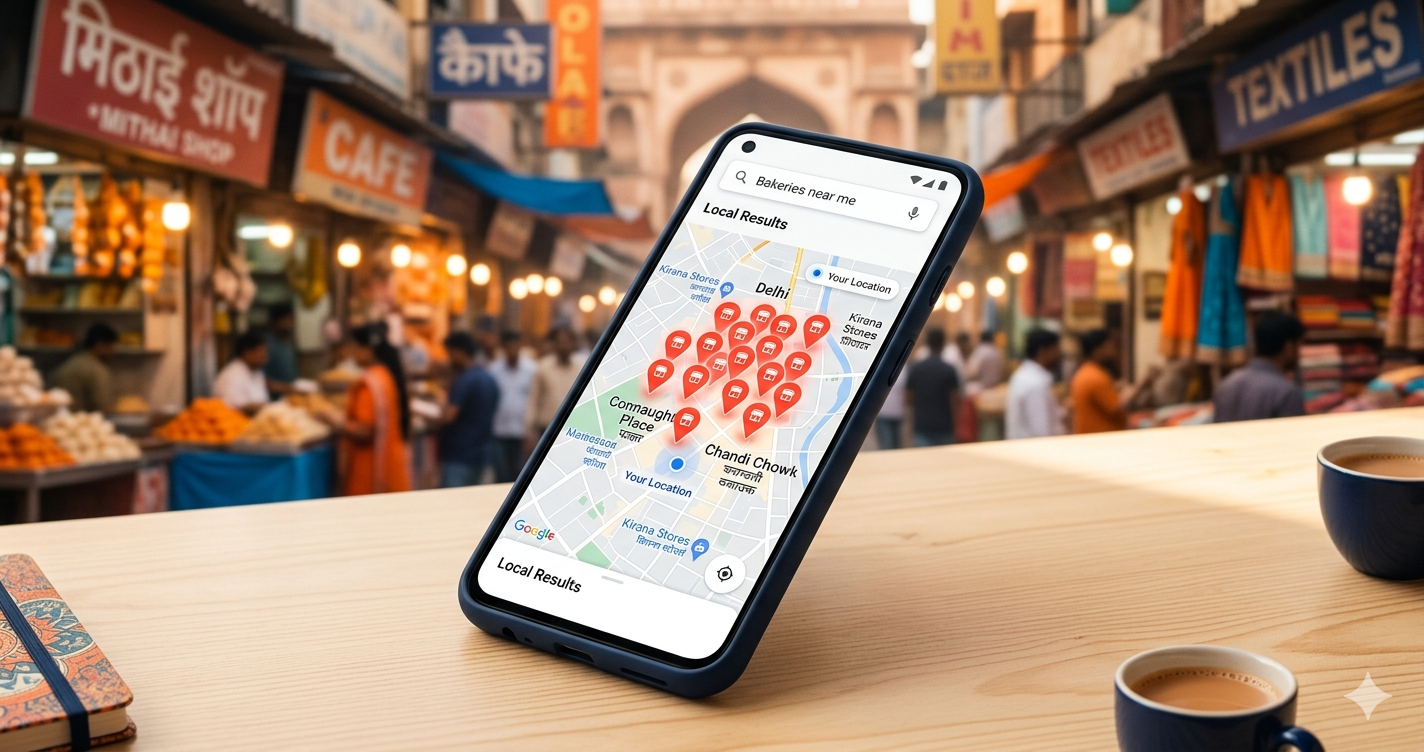
Imagine walking down a busy street anywhere in India looking for a specialty coffee roaster, restaurant, salon, or repair service. What is the first thing you do? You pull out your phone, open Google Maps or a search engine, and type a quick phrase. Within seconds, a handful of nearby businesses appear with ratings, reviews, operating hours, directions, and contact details.
This simple behavior highlights why local SEO in India has become one of the most important digital marketing strategies for businesses of all sizes. Modern consumers no longer spend time browsing multiple websites or scrolling through endless search results. Instead, they expect fast, location-specific answers that help them make immediate purchasing decisions.
If your business fails to appear during these high-intent local searches, you risk losing customers to competitors who are more visible online. A well-executed local SEO in India strategy helps businesses improve visibility, attract qualified local traffic, increase footfall, and connect with customers exactly when they are ready to take action. For neighborhood brands, local search visibility is no longer optional. It is a fundamental driver of growth and long-term success.

Why Businesses Fail Without Local SEO in India for Small Business
Many business owners spend significant budgets trying to rank for broad, nationwide keywords when their actual buyers live within a few kilometers of their location. This mismatch often results in wasted marketing spend, low-quality traffic, and poor conversion rates. While national visibility may seem attractive, most small businesses depend on local customers who are actively searching for nearby products and services.
Without a targeted local SEO for small business strategy, companies struggle to appear in relevant local searches. Even businesses with excellent products, competitive pricing, and strong customer service can lose potential customers if they are not visible when people search online. As a result, competitors with stronger local optimization often capture the majority of local demand.
The challenge is that consumer behavior has changed. Today, people search for solutions “near me” and expect immediate, location-specific results. Search engines prioritize proximity, relevance, and trust signals such as reviews, local citations, and accurate business information. Businesses that invest in local SEO gain better visibility, attract high-intent customers, and build a sustainable competitive advantage in their target market.
The Growing Importance of Local SEO in India
The way people discover local businesses in India has changed significantly in recent years. Instead of browsing directories or relying on word-of-mouth recommendations, consumers now turn to search engines to find nearby products and services. Whether someone is searching for a restaurant, clinic, salon, or repair service, search results are increasingly personalized based on location, intent, and relevance.
At the same time, search engines have become smarter. AI-powered search experiences analyze business listings, customer reviews, maps data, and website content to provide instant answers. This means businesses must ensure their local information is accurate, consistent, and easily accessible across digital platforms. Simply targeting keywords is no longer enough to maintain strong visibility in local search results.
This shift highlights the growing importance of local SEO in India. Businesses that optimize their online presence can attract more qualified local customers, improve trust, and increase conversions. Those that fail to establish a strong local footprint risk losing visibility to competitors who provide clearer location signals, stronger credibility, and a better overall user experience.
How Local Search Turns into a Customer
Search Query
Google Maps / Local Results
Business Profile Viewed
Reviews Checked
Website Visit / Call
Store Visit
Purchase
The 4-Pillar Engine for Google Business Profile Optimization
Building a reliable regional presence requires a systematic approach to formatting and structuring your business data. This framework ensures that search engines can easily find, verify, and display your brand to nearby shoppers.
- Establish Data Symmetry: Ensure your Name, Address, and Phone number are identical across your website, social media channels, and local directories. Even a tiny variation like writing “3rd Main Road” on one platform and “3rd Main” on another confuses search crawlers.
- Execute Google Business Profile Optimization: Claim your profile, select the most accurate primary category, and upload high-resolution photos of your storefront regularly. Keep your operational hours updated, especially during regional holidays, to build trust with both users and algorithms.
- Build Hyper-Local Citations: List your business on prominent Indian directories such as Justdial, Sulekha, and IndiaMART. Ensure that every single citation points back to the exact same address structure established in your initial setup phase.
- Cultivate Consistent Review Velocity: Encourage satisfied customers to leave detailed reviews mentioning your specific services and location names. Respond swiftly to every review, thanking positive reviewers and offering polite solutions to any negative feedback.
The Concrete Benefits of Local SEO
Consumer search behavior has shifted dramatically across India’s tier-1, tier-2, and tier-3 cities. Today, customers rely on search engines to find nearby businesses, compare options, read reviews, and make purchasing decisions. This trend has made local visibility a critical factor in business growth.
The numbers highlight the impact. Nearly 46% of all Google searches have local intent, meaning users are actively looking for products or services in their area. Additionally, 76% of people who perform a local search on their smartphones visit a related business within a day, while 28% of those searches result in a purchase. These statistics demonstrate why local SEO is one of the highest-converting digital marketing strategies available to businesses.
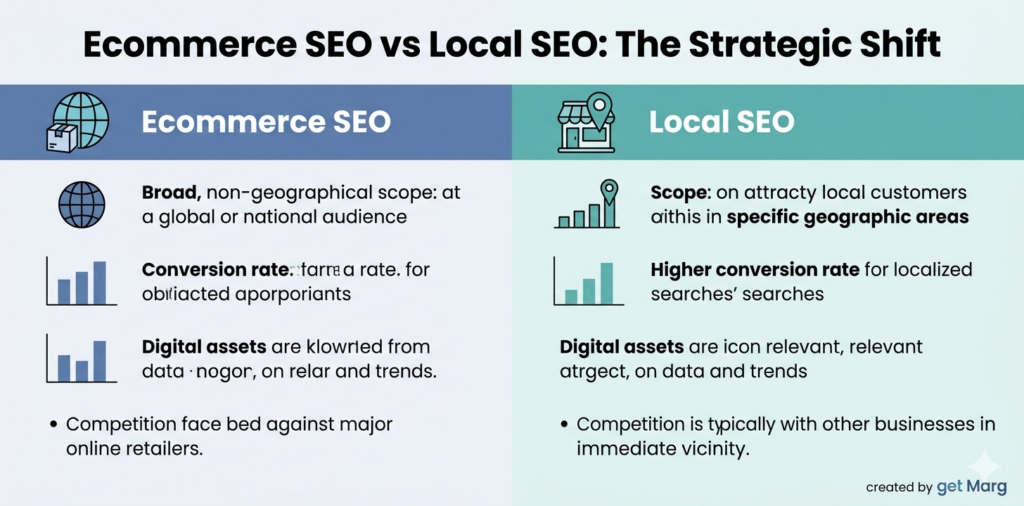
Ecommerce SEO vs Local SEO
| Strategic Attribute | Ecommerce SEO | Local SEO |
|---|---|---|
| Geographic Scope | National or international audiences | Specific cities, regions, or neighborhoods |
| Primary Goal | Online sales and transactions | Foot traffic, calls, bookings, and local leads |
| Core Assets | Product pages and category pages | Google Business Profile, citations, and local landing pages |
| Target Keywords | Broad, high-volume keywords | Location-specific, high-intent keywords |
| Competition | National brands and marketplaces | Local and regional competitors |
Understanding the difference between ecommerce SEO and local SEO is essential for allocating marketing resources effectively. While ecommerce SEO focuses on reaching a broad audience, local SEO targets customers who are actively searching for nearby solutions and are often closer to making a purchase decision. This targeted approach leads to higher conversion rates, stronger customer engagement, and sustainable business growth.
Real-World Case Study: How Zomato Proved the Importance of Local SEO in India
One of the best examples of the importance of local SEO in India is Zomato. Before becoming a leading food delivery platform, Zomato built its reputation as a restaurant discovery platform that helped users find dining options in their immediate area.
The company understood that users searching for restaurants were not looking for generic information. They wanted highly specific details such as location, menu prices, customer reviews, ratings, photos, and nearby dining options. To meet this demand, Zomato created dedicated pages for cities, neighborhoods, and popular food hubs across India. This allowed the platform to rank for thousands of location-based searches related to restaurants and dining experiences.
For example, users searching for restaurants in areas such as Connaught Place in Delhi or Indiranagar in Bengaluru could find highly relevant pages tailored to those locations. By organizing content around local intent rather than broad national keywords, Zomato improved search visibility and user experience simultaneously.
The key lesson for businesses is clear. Customers often search for solutions within a specific locality, not an entire city or country. Creating location-specific content, maintaining accurate business information, and optimizing for local search intent can significantly improve visibility and attract more qualified customers.
Where Brands Fail in Local SEO for Small Business
Inactive Listings
Duplicate Listings
No Local Content
Disconnected Strategy
Ignoring Reviews
Many businesses invest in local SEO expecting quick improvements in visibility and customer acquisition, yet they often overlook the fundamental practices that drive long-term success. In highly competitive local markets, even small operational mistakes can weaken search performance and make it easier for competitors to attract potential customers. From inaccurate business information to poor reputation management, these common errors can gradually reduce visibility, trust, and engagement, limiting the effectiveness of an otherwise strong local SEO strategy.
- Ignoring Active Listings: Leaving your business profile unverified or failing to update phone numbers, addresses, operating hours, and holiday schedules can create confusion and negatively impact local rankings.
- Creating Multiple Duplicate Listings: Setting up multiple listings for the same physical location in an attempt to gain more visibility often results in ranking issues, listing conflicts, or account suspensions.
- Neglecting Localized Website Copy: Failing to include city names, neighborhoods, landmarks, and location-specific service descriptions makes it harder for search engines to connect your business with relevant local searches.
- Siloing Digital Strategy: Treating in-store operations and digital marketing as separate functions can create a fragmented customer experience and weaken overall local search performance.
- Ignoring Bad Reviews: Leaving negative reviews unanswered signals poor customer service and can discourage potential customers while reducing trust in your brand.
Many of these mistakes seem minor individually, but their cumulative impact can significantly reduce local search visibility, customer engagement, and conversion opportunities. Businesses that maintain accurate listings, create localized content, actively manage reviews, and align online efforts with offline experiences are more likely to achieve sustainable local SEO success.d customer engagement. Successful local SEO requires consistent business information, active reputation management, and a strong connection between your online presence and offline operations. Businesses that regularly audit their local profiles and prioritize customer experience are more likely to achieve sustainable growth in local search results.
Launching Strategy for Local SEO in India
Launching a successful local SEO strategy requires more than simply creating a business listing and hoping customers find you. To achieve consistent visibility in local search results, businesses must focus on building trust, maintaining accurate information, and creating content that aligns with the needs of local audiences. A structured approach helps improve discoverability, strengthen customer confidence, and increase the likelihood of attracting high-intent local traffic. By following proven local SEO practices, businesses can establish a stronger presence within their target markets and generate sustainable long-term growth.
- Conduct a Local Citation Audit: Identify and correct inconsistent business information across directories, review platforms, and local listing websites.
- Optimize Your Website Footer: Include your business name, complete address, local phone number, operating hours, and service area information.
- Create Location-Specific Landing Pages: Develop dedicated pages that address the unique needs and search intent of customers in different cities, regions, or neighborhoods.
- Encourage Customer Reviews: Request feedback through QR codes, email follow-ups, SMS campaigns, or post-purchase communications.
- Update Your Google Business Profile Regularly: Publish new photos, business updates, offers, events, and accurate operational information.
- Use Localized Keywords Naturally: Incorporate location-specific search terms throughout your website content, metadata, headings, and business profiles.
- Track Local SEO Performance: Monitor rankings, website traffic, phone calls, direction requests, review growth, and customer engagement metrics.
Local SEO is not a one-time task. Consistent optimization, accurate business information, ongoing customer engagement, and regular performance monitoring are essential for maintaining visibility and attracting qualified local customers over the long term.
Essential Local SEO Insights
- Proximity drives purchasing decisions– Modern consumers prefer businesses that are nearby and easy to access. A strong local SEO strategy helps your business appear when potential customers are actively searching for products or services in your area.
- Consistent business information improves visibility– Maintaining accurate details such as your business name, address, phone number, and operating hours across directories helps search engines verify your legitimacy and improves local rankings.
- Customer reviews influence both rankings and trust– Positive reviews not only strengthen your local search presence but also encourage potential customers to choose your business over competing options.
- Local SEO and ecommerce SEO serve different goals– While ecommerce SEO focuses on reaching broad audiences and driving online sales, local SEO targets high-intent users who are looking for nearby solutions and are often ready to take immediate action.
- Location-specific content creates long-term value– Dedicated pages for cities, neighborhoods, or service areas help establish topical authority, improve search visibility, and attract qualified local traffic over time.
- Google Business Profile remains a critical asset– Regular updates, accurate information, fresh photos, and customer engagement can significantly improve your chances of appearing in local search results and map listings.
- Local SEO is a long-term investment– Businesses that consistently optimize their local presence build stronger brand awareness, attract more qualified leads, and create a sustainable competitive advantage within their target markets.
Conclusion
The digital landscape is moving rapidly toward a world where search engines answer questions instantly based on where the user is standing. The convenience of finding a verified, highly-rated service provider next door has permanently shifted consumer expectations.
Investing time into targeted local strategies is no longer just an optional marketing tactic; it is a foundational asset that grows in value over time. Brands that take control of their geographical digital presence today will secure the best digital real estate in their markets for years to come.
As you look to scale your neighborhood footprint, having an experienced partner makes all the difference. At GET Marg, we specialize in helping brands navigate the complexities of modern search ecosystems, performance marketing, and digital growth. Partnering with GET Marg ensures your business stays visible, relevant, and chosen by the consumers who matter most to your bottom line.
Are You Ready To Get Searched?
Ready to turn nearby searches into paying customers? Navigating map algorithms, review velocity, and citation consistency can feel overwhelming when you are running a business. Let GET Marg handle the complexities of your digital footprint. As your modern growth partner, GET Marg aligns your brand with local search trends, AI visibility, performance marketing, and lead generation to ensure your storefront dominates your target neighborhood. Reach out to GET Marg today, and let’s build a sustainable local growth engine together.
Frequently Asked Questions(FAQs)
Q1. What is the primary difference when comparing ecommerce SEO vs local SEO?
Global e-commerce optimization targets high-volume, non-geographical keywords to drive traffic to an online storefront regardless of user location. Local optimization focuses purely on capturing search intent within a specific geographic boundary to drive physical store visits or direct local inquiries.
Q2. How long does it take to see the benefits of local SEO for my store?
Most businesses notice an uptick in map views and phone inquiries within 4 to 8 weeks after executing a thorough Google Business Profile optimization campaign and cleaning up inconsistent citations across web directories.
Q3. Can a business without a physical storefront practice local SEO for small business?
Yes, service-area businesses that deliver products or services directly to customers at their locations can set up profiles highlighting their specific operational radiuses without publicly displaying a residential home address.
Q4. Why is there a growing importance of local SEO in India for tier-2 and tier-3 cities?
With rapid smartphone adoption and localized internet penetration across India, consumers in tier-2 and tier-3 cities increasingly search for “near me” businesses to fulfill immediate service and retail needs locally.
Q5. How do customer reviews impact my local SEO in India rankings?
Review volume, velocity, and positive sentiment tell search algorithms that your business is active, trustworthy, and popular among real users, which directly pushes your profile higher in local search results.