

The way people search online has changed dramatically over the last few years. Instead of typing short, fragmented keywords into search engines, users are increasingly turning to smartphones, smart speakers, and voice assistants to ask complete questions in natural language. This shift has made Voice Search Optimization an essential part of modern digital marketing strategies.
When someone types a query, they often use only a few words. However, voice searches tend to be longer, more conversational, and highly specific. Search engines now prioritize content that can quickly answer these spoken questions in a clear and concise manner. As a result, businesses can no longer rely solely on traditional SEO tactics focused on keyword placement and rankings.
To remain visible in today’s search landscape, brands must create content that mirrors natural speech patterns, addresses user intent directly, and delivers immediate value. Voice Search Optimization helps businesses adapt to this changing behavior, improving visibility across voice assistants, AI-powered search experiences, and modern search results.
What is Content Strategy for Voice Search?
A content strategy for voice search is the process of creating content that aligns with how real people speak when asking questions through voice assistants and AI-powered search platforms. Instead of targeting short, fragmented keywords, businesses must anticipate complete conversational queries and provide immediate, easy-to-understand answers that search engines can confidently deliver as spoken responses.
This approach has become increasingly important as voice search ranking factors continue to evolve around user intent, natural language processing, mobile experience, and answer quality. Modern search engines no longer focus solely on matching keywords; they aim to understand the context behind a spoken question and identify the most relevant answer available.
🎙️ How Voice Search Works
Traditional Search
“Digital marketing agency Delhi”
Voice Search
“Best agency near me?”
Optimized Content
Direct answers & natural language
For example, a traditional search might be “digital marketing agency Delhi.” A voice query, however, is more likely to sound like, “Which digital marketing agency in Delhi can help me generate more leads for my business?” The difference may seem small, but it completely changes how content should be written and optimized.
Understanding how to optimize content for voice search means moving beyond conventional SEO tactics and creating content that mirrors natural human conversations. This includes using question-based headings, providing concise answer blocks, incorporating structured data, and addressing the specific problems users are trying to solve.
Why Traditional SEO Content Fails Spoken Queries
The biggest trap businesses fall into is assuming that standard SEO practices will naturally carry over into voice search results. Traditional SEO content is frequently optimized for short-tail, robotic phrases that no human would ever say out loud. When your content is structured around artificial keyword strings rather than natural conversational sentences, voice search ranking factors will work against you, dropping your visibility significantly.
Another major hurdle is the reality of zero-click searches. When a user conducts a traditional text search, they are presented with a full page of links, giving your site multiple opportunities to earn a click. With a voice query, the assistant usually provides only one definitive answer. If your content is buried in lengthy, vague paragraphs instead of being formatted for immediate extraction, you lose the position entirely.
This causes a frustrating disconnect for business owners who invest heavily in content that simply doesn’t convert into voice answers. The underlying issue isn’t a lack of information on your website; it is an architectural flaw in how that information is served. If an AI assistant or a voice engine cannot instantly find a concise, 40-to-60-word snippet that cleanly answers a user’s question, it will move on to a competitor who structured their page correctly.
Understanding the 2026 Voice and AI Landscape
The rapid growth of voice interactions is deeply tied to the rise of AI answer engines and conversational search algorithms. Modern search systems do not just match exact text strings anymore; they use natural language processing to understand the deeper intent behind a user’s spoken words. This means your content strategy for voice search must prioritize topical authority and natural language context over old-school keyword metrics.
We are seeing a major convergence between voice queries and AI summaries across all major platforms. When a user speaks a question, the voice assistant often pulls its spoken response directly from an AI overview or a featured snippet block at the top of the search results page. If you want your business to be the single answer spoken back to a customer, your digital marketing assets must be built to satisfy these advanced technical systems.
Furthermore, device behavior has diversified significantly. People are executing voice commands through their car dashboards, smartwatches, and home appliances, which places a massive premium on hyper-local data and immediate utility. Optimizing for this landscape requires a deep understanding of entity-based SEO, where search engines connect real-world businesses, locations, and consumer questions into a seamless web of instant information.
How to Build a Content Strategy for Voice Search
Many brands recognize that people are speaking to search engines differently than they type, yet their websites continue to rely on the same content structures that were designed for traditional search. As a result, they create valuable content that ranks reasonably well but rarely becomes the answer selected by voice assistants or AI-powered search experiences.
The challenge lies in the fact that voice search rewards a different type of content architecture. Search engines need to quickly identify the question being asked, understand the context behind it, and extract a clear answer that can be delivered instantly to the user. If your content makes that process difficult, even high-quality information may never surface in voice search results. This is why businesses need a deliberate content strategy for voice search rather than a collection of isolated optimization tactics. Every element, from keyword research and content structure to technical performance and schema implementation, should work together to make information easier to discover, interpret, and present.
The good news is that building an effective strategy does not require a complete overhaul of your website. It requires a structured approach that aligns your content with how modern users search and how search engines process spoken queries. The framework below outlines the key areas businesses should focus on to strengthen their voice search SEO efforts and improve their visibility across voice-enabled platforms.
The 4-Step Content Strategy for Voice Search Framework
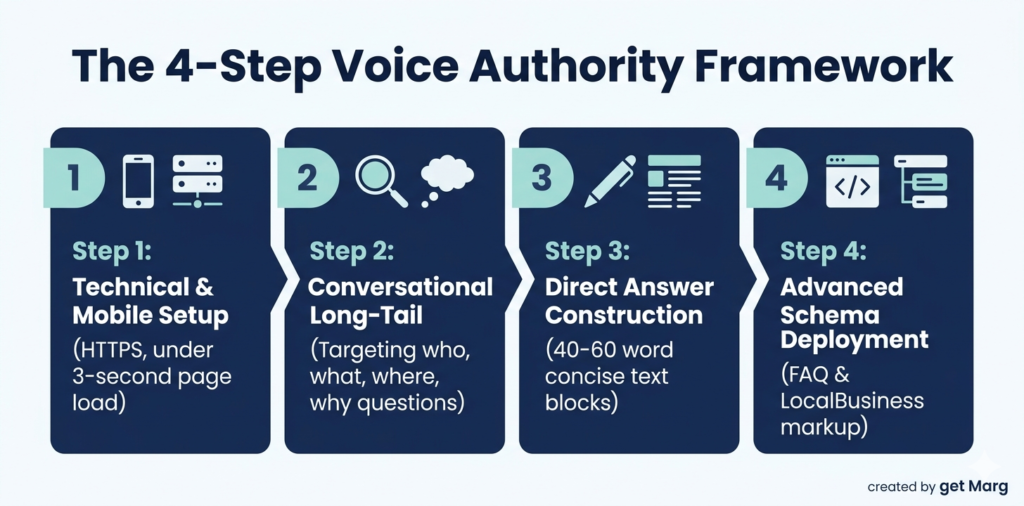
To systematically align your website with modern voice search ranking factors, you need a repeatable operational blueprint. This framework is designed to transform standard text-heavy pages into highly machine-readable, voice-friendly assets.
1.Establish Technical and Mobile Prerequisites
Secure your entire website with an HTTPS connection and optimize your mobile responsive design. Because the vast majority of voice queries happen on mobile devices on the go, your site must load instantly to be considered for a spoken result.
2.Map Conversational Long-Tail Questions
Identify the exact who, what, where, why, and how questions your target audience asks out loud. Move away from generic phrases and document the natural, conversational long-tail strings used by real customers during everyday business interactions.
3.Construct Dedicated Direct Answer Blocks
Position a clear, conversational answer of 40 to 60 words directly beneath your question-based headings. This provides search algorithms with an easily extractable snippet that can be read aloud effortlessly by any voice assistant.
4.Deploy Advanced Structured Schema Markup
Implement detailed FAQ, LocalBusiness, and Product schema code across your key landing pages. This backend formatting explicitly tells search engines exactly what your content means, making it highly eligible for position zero rankings.
Data, Statistics, and Trends Shaping Voice Behavior
Understanding the actual metrics behind voice search SEO helps clarify why this shift is so urgent for growing brands. The numbers indicate that voice interactions have moved from a tech novelty to a dominant form of consumer search behavior.
| Metric Type | Current Status | Strategic Business Impact |
| Daily Global Volume | Over 1.8 billion voice searches processed per day | Requires immediate conversational optimization across all web assets |
| Mobile Query Share | Around 42% of all mobile searches are now voice-driven | Makes lightning-fast mobile loading speeds absolutely non-negotiable |
| Answer Sourcing | Roughly 41% of voice answers come from featured snippets | Proves that structured snippet ownership is the primary path to voice visibility |
| Local Consumer Intent | Nearly 76% of smart speaker owners run local business searches weekly | Directly drives physical foot traffic and immediate local service calls |
The shift toward voice also highlights a dramatic change in query architecture. While a typical typed search consists of only 3 to 4 short words, the average voice search query extends to a much longer, multi-word conversational sentence. Around 70% of these spoken searches are phrased as complete, standalone questions rather than fragmented phrases. Additionally, businesses that actively execute an optimized content strategy for voice search report a substantial 28% average increase in organic traffic compared to those relying solely on legacy text methods.
Content Strategy for Voice Search vs Traditional SEO
While traditional SEO focuses on helping users find information, a content strategy for voice search focuses on delivering the most accurate answer in the shortest possible time. Businesses that optimize for both are better positioned to capture traffic from modern search experiences, AI assistants, and voice-enabled devices.
| Aspect | Traditional SEO | Content Strategy for Voice Search |
| User Behavior | Users type short keyword phrases. | Users ask complete questions in natural language. |
| Search Intent | Often broad and exploratory. | Usually specific, immediate, and action-oriented. |
| Keyword Focus | Short-tail and medium-tail keywords. | Conversational long-tail queries and questions. |
| Content Structure | Optimized for scanning and clicking. | Optimized for direct answers and spoken responses. |
| Primary Goal | Earn rankings and clicks. | Become the answer selected by voice assistants. |
| Result Format | Multiple search results compete for attention. | Often a single answer is delivered to the user. |
| Featured Snippets | Helpful but not always essential. | Critical for voice search visibility. |
| Content Style | Keyword-focused and informational. | Conversational, concise, and intent-driven. |
| Local Search Importance | Important for local businesses. | Extremely important due to “near me” voice queries. |
| Success Metric | Rankings, traffic, and CTR. | Answer visibility, featured snippets, and voice presence. |
How Dominos Mastered Voice Commerce
A brilliant example of a brand completely reshaping its digital growth through voice technology is Domino’s Pizza. Recognizing early on that consumer convenience was shifting toward hands-free environments, they launched their proprietary voice-ordering assistant, Dom. Instead of forcing hungry customers to navigate a multi-step mobile checkout screen, they allowed users to simply speak their orders naturally to their devices.
Domino’s didn’t just build a standalone tool; they meticulously aligned their broader digital marketing infrastructure to support conversational inputs. They structured their menu items, pricing data, and local store information so that search systems and voice engines could instantly parse the options. Whether a customer asked a smart speaker for a nearby delivery option or used the app to reorder a favorite meal, the system processed the conversational query instantly.
The results of this forward-thinking content strategy for voice search were massive. By removing all friction from the purchasing process, Domino’s saw an enormous surge in mobile app engagement and digital orders. This execution proved that voice optimization is not just an abstract SEO tactic; it is a powerful revenue driver that helps modern e-commerce brands capture high-intent customers at the exact moment they are ready to buy.
Where Most Modern Brands Lose Voice Visibility
- Writing in a Rigid, Corporate Voice: Creating overly formal, text-book style copy that sounds completely unnatural when read aloud by a smart device.
- Ignoring Local Search Signals: Failing to fully claim, verify, and update your Google Business Profile with precise operating hours, current phone numbers, and localized neighborhood phrases.
- Neglecting Mobile Page Loading Speeds: Allowing uncompressed images or messy code to slow down your mobile site, which causes search engines to disqualify you from quick voice answers.
- Omitting Structured Schema Code: Leaving your website without the backend FAQ or LocalBusiness markup that algorithms rely on to verify your data accuracy.
- Forgetting to Audit Legacy Content: Leaving old blog posts and landing pages optimized exclusively for short, robotic keyword strings instead of refreshing them with conversational questions.
Implementing Your Content Strategy for Voice Search
- Conduct a Conversational Keyword Audit: Review your existing top-performing pages and identify opportunities to replace short, robotic keyword phrases with natural, long-tail questions that match real voice search SEO patterns.
- Rewrite Headers into Clear Questions: Convert your standard H2 and H3 subheadings into direct, user-focused questions using conversational terms like how to optimize content for voice search.
- Insert 50-Word Direct Answer Blocks: Add a concise, authoritative answer block of 2 to 3 sentences immediately beneath every question-based heading to cleanly target featured snippets.
- Optimize Your Core Web Vitals: Work with your development team to compress media assets, eliminate code bloat, and ensure your site achieves a mobile page load speed under 3 seconds.
- Build a Dedicated, Schema-Backed FAQ Page: Create a comprehensive FAQ section covering your most common customer inquiries, and apply structured FAQPage schema markup to the backend code.
Voice Search SEO Checklist
🎙️ What Makes a Website Voice-Search Ready?
Answers Questions
Uses Natural Language
Loads Fast
Uses Schema
Voice Visibility
As voice search continues to reshape how users discover information online, businesses should ensure their digital presence is aligned with the factors that influence voice search visibility.
- Answers customer questions directly
- Uses natural, conversational language
- Targets long-tail and question-based queries
- Includes concise answer blocks beneath key headings
- Optimizes content for featured snippets
- Implements FAQ and structured schema markup
- Loads quickly across mobile devices
- Maintains a secure HTTPS connection
- Prioritizes local SEO and Google Business Profile optimization
- Regularly updates content to reflect changing search behavior
Businesses that consistently perform well in voice search tend to share a common set of characteristics.
Building Long-Term Digital Value
Succeeding in the modern search environment requires looking beyond the immediate horizon and building digital marketing assets that align with actual human behavior. Voice search optimization is not a passing technical trend or a minor adjustment to your web copy; it is a fundamental reconfiguration of how your business communicates with search engines and consumers alike. When you build content that speaks naturally, you establish a resilient digital presence that can withstand algorithm updates and platform shifts.
As AI engines and smart devices continue to integrate deeper into our daily lives, the brands that commit to clarity, structure, and accessibility will naturally lead their industries. Transforming your website to answer real questions out loud ensures you are building genuine, long-term authority. By focusing on giving your audience the exact, immediate answers they need, you create a seamless bridge between user intent and your business solutions.
Partnering with an experienced digital growth ally can make this technical transition smooth and incredibly rewarding. If you are ready to modernize your digital footprint, the team at GET Marg is here to help. We specialize in designing advanced content strategy blueprints, executing precise voice search SEO updates, and optimizing your brand for maximum visibility across modern AI platforms, social media, and performance marketing channels to drive sustainable lead generation.
Frequently Asked Questions(FAQs)
Q1. What is the voice search optimization?
Voice search optimization is the process of improving website content and technical performance so voice assistants and search engines can easily understand, extract, and deliver information as spoken answers. It focuses on conversational queries, direct answers, mobile usability, page speed, and structured data to improve visibility in voice search results.
Q2. Is voice search optimization worth it?
Yes, voice search optimization is increasingly valuable as more users rely on smartphones, smart speakers, and AI assistants to find information. Businesses that optimize for voice search can improve visibility, capture high-intent traffic, strengthen local search performance, and increase their chances of appearing in featured snippets and AI-generated answers.
Q3. How do I optimize for voice search?
To optimize for voice search, create content around conversational questions, provide concise answers, improve mobile page speed, implement schema markup, and target featured snippets. It is also important to focus on local SEO and natural language phrases that reflect how users speak rather than how they type.
Q4. What are the main voice search ranking factors?
The most important voice search ranking factors include mobile responsiveness, fast page loading speed, HTTPS security, structured schema markup, featured snippet visibility, content relevance, and local SEO signals. Search engines also favor content that clearly answers user questions and aligns closely with conversational search intent.
Q5. Do small business owners really need to care about voice search SEO?
Absolutely. Many voice searches have local intent, with users looking for nearby businesses, services, or products. By investing in voice search SEO, small business owners can improve local visibility, attract qualified leads, and increase their chances of being recommended by voice assistants when customers need immediate solutions.