The digital landscape has shifted beneath our feet. If you spent the last week staring at a blinking cursor trying to figure out an Instagram hook, or watching your engagement metrics flatline despite posting three times a day, you are not alone. Modern social media channels have transformed into highly competitive ecosystems where algorithmic discovery dictates business success, and manual production simply cannot scale fast enough to survive.
The truth is that content creators, business owners, and marketing professionals are facing a severe operational bottleneck. Audiences are increasingly selective about what they consume, demanding authentic, highly interactive experiences, while platforms demand a relentless volume of short-form video, carousels, and perfectly timed updates. Trying to run this treadmill entirely by hand is a quick path to creative exhaustion and strategic irrelevance.
Using modern AI tools for social media is no longer an optional shortcut for tech-savvy early adopters. It is the fundamental baseline for anyone who wants to preserve their creative energy while building a predictable engine for audience acquisition. The goal isn’t to hand over your entire brand to a cold, robotic voice; it is to deploy smart systems that handle the heavy lifting of formatting, scheduling, and analyzing, allowing your unique human perspective to shine through.
Why Manual Social Media Systems Are Failing Today
The core problem isn’t that you lack great ideas. The problem is that the modern social media landscape forces you to spend 80% of your time on low-leverage operational tasks instead of deep creative execution. Between cutting video clips, formatting text variations for three different platforms, analyzing raw spreadsheets, and hunting down relevant hashtags, the actual “creativity” gets buried under mountains of digital administrative work.
When you try to manage your channels using outdated processes, your content inevitably suffers from three major structural points of failure:
- The Velocity Deficit: Algorithms prioritize consistent, high-value signals. When production slows down due to manual friction, your distribution numbers crater.
- Context Fragmentation: A great text post on LinkedIn fails on Instagram. Manually translating a single core idea into multiple platform-native formats consumes hours of mental energy that could be spent on product or community.
- The Analytical Blindspot: Standard dashboards show you what happened last week, but they do not tell you why an audience behaved that way or what they want to see tomorrow.
This creates a vicious cycle where creators and business owners work twice as hard for half the visibility. You feel the constant pressure to produce, but lack the infrastructure to sustain it.
The AI Shift: Moving from Brute Force to Algorithmic Synergy
To understand why this bottleneck exists, we have to look at how social platforms have evolved. We are living in an era of semantic SEO, entity recognition, and interest-graph recommendation systems. Platforms like TikTok, YouTube, and Instagram now collectively drive over 60% of product discovery, while traditional search sits at less than 35%. Algorithms are no longer just looking at keywords; they are analyzing real-time consumer behavior patterns, intent, and cultural trends to build hyper-personalized discovery feeds.
When you integrate trends in AI marketing tools into your workflow, you align your distribution system with how modern platforms actually rank and distribute content. AI doesn’t just write copy; it decodes audience signals at scale. It maps consumer trends, patterns text structures to match what recommendation engines prioritize, and identifies optimal engagement windows that humans miss.
By shifting your strategy from manual brute force to data-backed automation, you transform social media from an unpredictable guessing game into a measurable growth loop. You stop guessing what might work and start executing workflows that build long-term topical authority across every active channel.
Best AI Tools for Social Media in 2026
Building a successful social media presence today requires more than creativity alone. Brands must consistently publish high-quality content, monitor audience engagement, analyze performance metrics, and adapt to rapidly changing platform algorithms. This is why modern marketers increasingly rely on AI tools for social media to streamline workflows and improve results.
The best platforms do not replace human creativity. They enhance it by automating repetitive tasks and providing data-driven insights. Below are some of the most effective AI-powered tools helping creators, businesses, and marketing teams scale their social media efforts in 2026.
AI Tools for Content Writing
These tools primarily help with content creation, copywriting, caption generation, scripts, and marketing messaging.
ChatGPT
ChatGPT has become an essential tool for content creators and marketers looking to accelerate content production. It can generate post ideas, social media captions, hashtag suggestions, video scripts, content calendars, and audience engagement responses in minutes. The platform is particularly valuable during the ideation stage, helping teams overcome creative blocks and rapidly develop multiple content angles around a single topic. Many businesses use ChatGPT to draft content frameworks before refining them with their own brand voice and expertise.
Best For: Content ideation, captions, scripts, content planning, and audience engagement.
Jasper AI
Jasper is designed specifically for marketers and businesses that need high-volume content production. The platform excels at generating promotional copy, campaign messaging, product announcements, and social media content tailored to specific audiences. Its brand voice capabilities help organizations maintain consistency across channels while producing content at scale.
Best For: Marketing campaigns, promotional content, and brand messaging.
Copy.ai
Copy.ai focuses on helping businesses produce concise, persuasive marketing content. The platform can generate social media captions, ad copy, product descriptions, and promotional messaging tailored to different audiences. It is particularly useful for brands running multiple campaigns simultaneously and needing rapid content variations.
Best For: Social media copy, ad creatives, and marketing messaging.
AI Social Media Management Tools
These platforms combine content creation, scheduling, publishing, collaboration, and performance tracking to streamline social media workflows.
Buffer AI Assistant
Buffer combines content scheduling with AI-assisted content optimization. Users can create, refine, and publish content across multiple social media platforms from a centralized dashboard. Its AI Assistant helps improve post quality by suggesting alternative captions, refining messaging, and generating fresh content ideas based on existing drafts.
Best For: Content scheduling, workflow management, and publishing consistency.
Hootsuite OwlyWriter AI
Managing multiple social channels can become overwhelming as brands grow. Hootsuite addresses this challenge by combining scheduling, monitoring, reporting, and AI-powered content generation in a single platform. OwlyWriter AI helps marketing teams create content faster while maintaining platform-specific best practices.
Best For: Large teams, agencies, and enterprise-level social media management.
Sprout Social
Creating content is only part of the equation. Understanding audience behavior is equally important. Sprout Social provides advanced analytics, social listening capabilities, competitor tracking, and engagement insights. Its AI-powered reporting tools help businesses identify trends, monitor sentiment, and make smarter content decisions based on real audience data.
Best For: Analytics, audience insights, and social listening.
AI Tools for Social Media Marketing
These tools are designed to help marketers create engaging visual content, optimize campaigns, and improve overall social media performance.
Canva Magic Studio
Visual content remains one of the strongest drivers of social media engagement. Canva’s AI-powered Magic Studio simplifies the design process by generating graphics, social media posts, presentations, and marketing materials with minimal effort. Features such as Magic Design, AI image generation, background removal, and automated resizing allow businesses to create professional-quality assets for multiple platforms without requiring advanced design skills.
Best For: Social graphics, carousel posts, branded visuals, and marketing creatives.
Predis.ai
Predis.ai is built specifically for social media marketers. The platform can automatically generate captions, hashtags, reels, carousel posts, and creative assets from simple text prompts. Businesses looking to scale content production without dramatically increasing costs often use Predis.ai as a dedicated social media content engine.
Best For: Automated content generation, reels, carousels, and short-form social content.
Rather than searching for a single perfect platform, many successful brands combine multiple AI tools for social media to build a complete content creation, distribution, and optimization system. This hybrid approach delivers greater flexibility while ensuring every stage of the social media workflow is supported by intelligent automation.
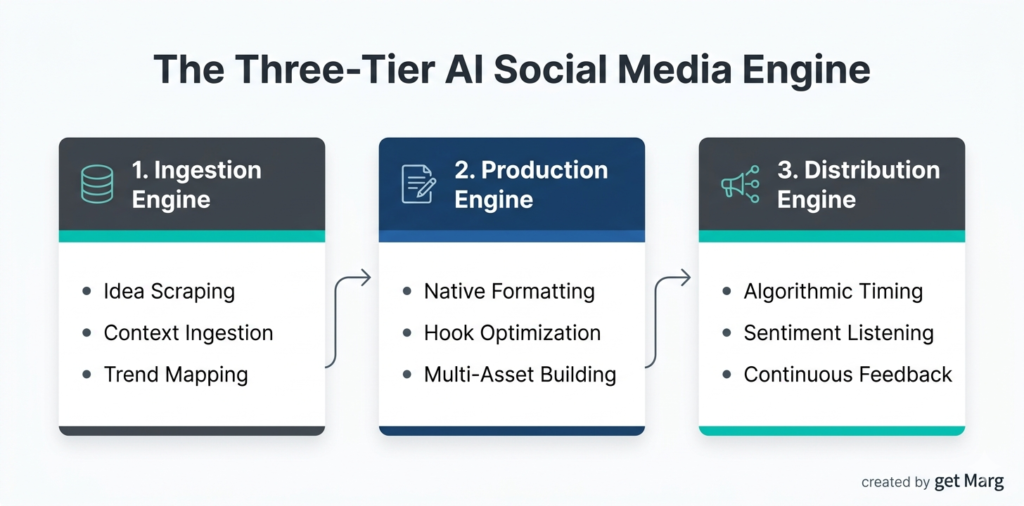
The Three-Tier AI Social Media Engine Framework
To scale your channels effectively, you need a structured operational framework. Instead of treating AI as a random collection of chat windows and prompt generators, you must organize your tech stack into a clean, functional engine. This system divides your workflow into three distinct stages to guarantee production never grinds to a halt.
The Reality of Modern Content Automation
To fully grasp the scale of this shift, look at how the broader market is adapting to automated workflows. The data shows a clear dividing line between companies sticking to manual processes and those building algorithmic systems.
| Marketing Metric | Manual Workflows | AI-Optimized Systems |
| Content Production Time | 6 to 8 Hours per Asset | Less than 45 Minutes per Asset |
| Platform Distribution | Single-Channel Focus | Multi-Channel Omnipresence |
| Data Processing Capacity | Historical / Retrospective | Real-Time / Predictive |
| Average Engagement Lift | Variable / Unpredictable | 22% Baseline Increase |
Around 51% of modern marketing teams now use intelligent systems specifically to optimize their copy and structural layout. Furthermore, enterprise data shows that companies deploying automated content systems cut their total blog and social copy production time by nearly 60%.
Social media apps capture an average of 2 hours and 40 minutes of daily user attention globally, and these platforms are now the primary driver of brand awareness for audiences aged 16 to 34. With total social ad spend projected to cross $317 billion, maintaining an organic visual footprint through streamlined production is the only way to offset rising paid acquisition costs.
How Heinz Let AI Write Their Creative Brief
When looking at real-world success, you don’t need to look further than a legacy brand like Heinz. They wanted to prove that their brand was completely synonymous with the very concept of ketchup in the minds of global consumers. Instead of hiring a traditional agency to spend three months drawing concepts by hand, they turned directly to generative AI tools during the early waves of text-to-image technology.
Raw Consumer Insight
Audience perception and brand association data collected from real users.
AI Prompt
“Ketchup”
AI Generates
Heinz Bottle Imagery
Heinz ran a campaign where they prompted advanced image generators with the simple word “ketchup” alongside various stylistic modifiers like “ketchup in outer space” or “ketchup as a Renaissance painting.” The system consistently generated images that looked unmistakably like the iconic Heinz glass bottle.
The marketing team turned these AI-generated graphics directly into social media posts, interactive community challenges, and physical billboards, inviting their audience to submit their own prompts. The campaign generated over 850 million organic impressions globally, driving massive social media engagement without requiring an enterprise-scale production budget. They proved that when a brand uses digital tools to spark community interaction, the audience becomes an active participant in the story.
Five Critical Pitfalls in Social Media Automation
Building a system using an AI tools for social media marketing suite requires strategic oversight. Avoid these common operational mistakes that can damage your brand equity:
- Mass-Producing Low-Value Noise: Using generative systems to dump twenty generic posts a day onto your channels will trigger platform spam filters and alienate your community. High volume must never come at the expense of genuine information gain.
- Skipping the Human Review Filter: Publishing raw, unedited AI drafts directly to your profiles is a recipe for brand damage. AI should write your first draft, but a human must always write the final version to inject real perspective and personality.
- Ignoring Platform-Specific Nuances: Dropping a text block with generic formatting across LinkedIn, Instagram, and X simultaneously signals to the audience that you don’t respect their space. Every platform requires custom hooks and custom layouts.
- Neglecting Community Management: Automation can schedule your posts, but it cannot build real human relationships. If you use tools to publish content but fail to jump into the comments section to talk to your audience, your conversion rates will drop.
- Relying on Outdated Prompting Structures: Giving vague instructions like “write a funny social post” results in generic, corporate copy. Your prompts must contain deep contextual data, clear audience personas, structural constraints, and explicit brand style guidelines.
Building Your Automated Production Stack
If you want to transition your channels from manual grinding to an automated system this week, follow this explicit execution sequence:
Step 1: Establish Your Central Knowledge Base
Build a centralized repository containing your core brand guidelines, verified customer pain points, past high-performing hooks, and target audience personas. This data acts as the grounding context for every script, caption, and asset you generate, ensuring your brand voice remains uniform across tools.
Step 2: Set Up an Automated Multi-Channel Workspace
Connect your social media profiles to an intelligent management workspace that offers predictive scheduling features. Configure your publishing queue to match your audience’s historical activity peaks, allowing the software to handle multi-platform distribution while you focus on content design.
Step 3: Create a Dedicated Short-Form Video Pipeline
Deploy a media clip engine to automatically scan your long-form video assets, webinars, or podcast episodes. Let the system isolate high-impact hooks, generate accurate vertical layouts, and apply auto-captions, turning a single hour of video into a month’s worth of short-form vertical content.
Step 4: Run Real-Time Content Sentiment Audits
Every 14 days, feed your performance data and comments into an analytical model to run a deep sentiment review. Identify which specific topics, visual styles, and conceptual angles sparked positive audience interactions, and instantly adjust your next production calendar based on those data points.
Securing Your Digital Footprint for the Era Ahead
The future of social media growth belongs to those who know how to blend human intuition with algorithmic scale. Sticking to traditional, manual production systems out of habit isn’t an act of artistic integrity; it is an operational vulnerability that limits your reach and drains your creative energy. The digital spaces where your customers spend their time are moving too fast for brute force to keep pace.
By treating automation as a core partner in your distribution engine, you unlock the freedom to focus on what matters most: building deep relationships, refining your strategic vision, and creating memorable brand experiences. The tools are ready to handle the grind. Your job is to step into the role of the director, guiding the system to build an unmissable online presence.
Partnering for Scale: Designing a Smarter Digital Architecture
Building a streamlined content engine that consistently ranks across search and social channels requires more than just picking a few random software subscriptions. It demands a holistic digital growth strategy that aligns your production workflows with modern algorithmic discovery. If you are ready to stop fighting creative friction and start building a high-performing digital footprint, you need a modern strategic partner.
GET Marg works alongside growing brands, content creators, and business leaders to design custom content strategies, performance marketing systems, and lead generation frameworks built for the modern internet. We help you transition away from inefficient manual processes, deploying smart systems that amplify your organic visibility and turn digital attention into predictable business growth. Let’s design a modern growth system that scales your business without losing your brand’s true voice.
Frequently Asked Questions(FAQs)
Q1. Which AI tool is best for social media?
ChatGPT is among the best AI tools for social media because it helps with content creation, caption writing, content planning, and audience engagement. Many marketers combine it with AI social media management tools for better results.
Q2. What are AI tools for social media mainly used for?
AI tools for social media are mainly used for content creation, scheduling, analytics, audience engagement, and campaign optimization. They help businesses automate workflows and improve efficiency in social media marketing.
Q3. What is the 5 3 2 rule for social media?
The 5-3-2 rule suggests sharing five pieces of curated content, three pieces of original content, and two personal or engaging posts. This balance improves audience trust and supports effective social media marketing.
Q4. What is the best way to handle short-form video creation using automated pipelines?
The best approach is combining AI tools for content writing, video generation, editing, and scheduling. Automated workflows streamline production, maintain consistency, and align with emerging trends in AI marketing tools.
Q5. Will using automated tools cause my organic reach to drop on social networks?
No. Using AI tools for social media marketing does not automatically reduce organic reach. Success depends on content quality, audience relevance, engagement, and strategic use of automation rather than excessive posting.