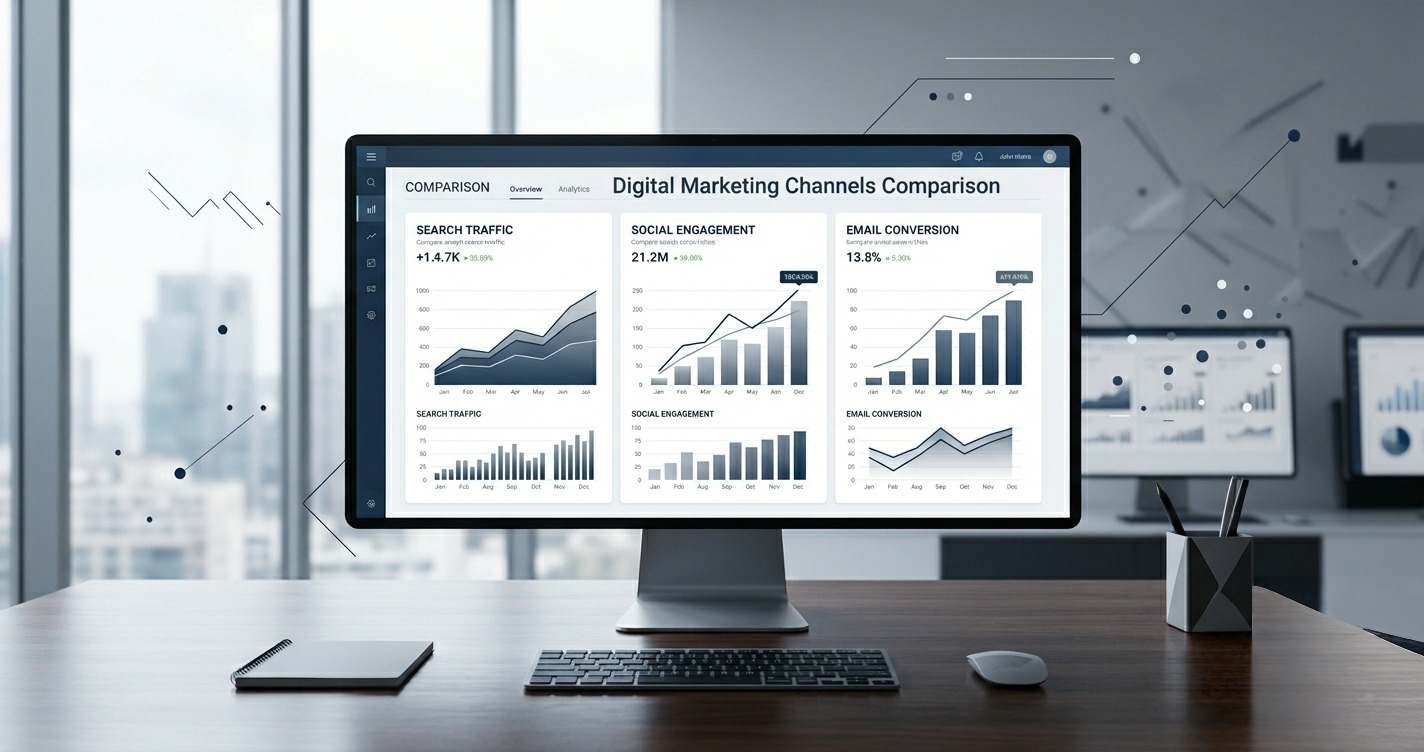
Let me guess. Someone told you to “just run Google Ads.” Someone else said Instagram is where it is all happening. Your competitor is doing influencer marketing. And a well-meaning friend told you to start a YouTube channel.
Now you are staring at your screen, trying to figure out which of these actually makes sense for your business – with the budget you have, the team you have, and the goals you are actually trying to hit.
That is exactly what this guide is for — a clear, practical online marketing channels comparison that helps you make a real decision.
We are going to do a real, honest digital marketing channels comparison and online marketing channels comparison – not a theoretical overview, but a practical breakdown of what each channel does, what it costs, how fast it works, and who it actually makes sense for. Especially if you are running an Indian small business, a D2C brand, a startup, or a service-based company. No fluff. No generic advice. Just a practical digital marketing channels comparison that helps you make a real decision.
What Are Digital Marketing Channels?
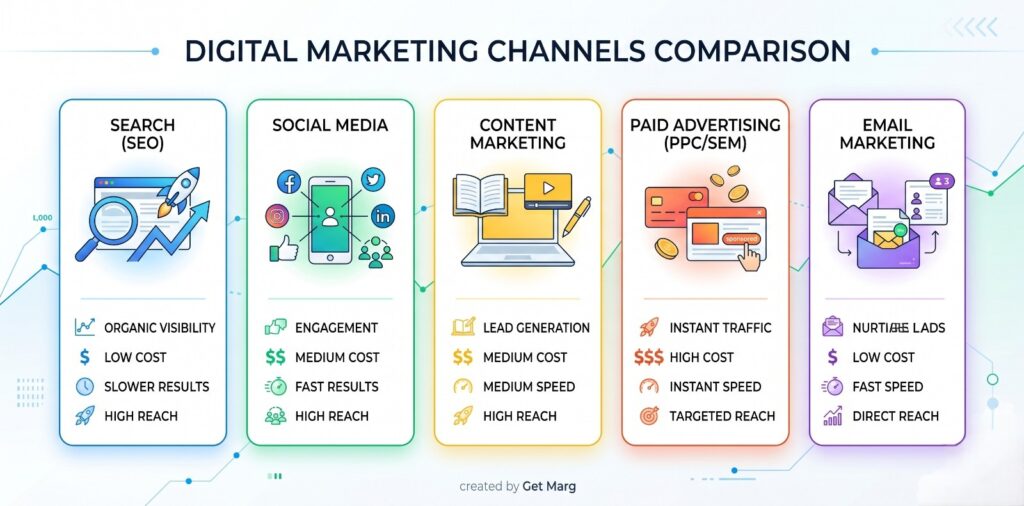
Digital marketing channels are simply the different ways your business can reach people online. The types of digital marketing channels vary widely — some reach people when they are actively searching, others when they are scrolling, reading email, watching a video, or chatting on WhatsApp.
Think of it like this. Your ideal customer is out there right now. Maybe she is searching Google for a solution to a problem you solve. Maybe he is scrolling Instagram during his lunch break. Maybe she just opened her email. The question is — where are you showing up?
The main types of digital marketing channels available in 2026 are:
- Search Engine Optimization (SEO)
- Pay-Per-Click Advertising (PPC / Google Ads)
- Social Media Marketing (organic + paid)
- Email Marketing
- Content Marketing
- Video Marketing
- Influencer Marketing
- WhatsApp and Messaging Marketing
Each one works differently, costs differently, and delivers results at a completely different pace. Understanding the types of digital marketing channels is the whole point of this comparison — to help you figure out which roads to take, not just list every road that exists.
Why Digital Marketing Channels Comparison Matters More Than Ever
Digital marketing channels are simply the different ways your business can reach people online. The types of digital marketing channels vary widely — some reach people when they are actively searching, others when they are scrolling, reading email, watching a video, or chatting on WhatsApp.
Think of it like this. Your ideal customer is out there right now. Maybe she is searching Google for a solution to a problem you solved. Maybe he is scrolling through Instagram during his lunch break. Maybe she just opened her email. The question is – where are you showing up?
The main types of digital marketing channels available in 2026 are:
- Search Engine Optimization (SEO)
- Pay-Per-Click Advertising (PPC / Google Ads)
- Social Media Marketing (organic + paid)
- Email Marketing
- Content Marketing
- Video Marketing
- Influencer Marketing
- WhatsApp and Messaging Marketing
Each one works differently, costs differently, and delivers results at a completely different pace. Understanding the types of digital marketing channels is the whole point of this comparison – to help you figure out which roads to take, not just list every road that exists.
1. Search Engine Optimization (SEO)
What It Actually Is
SEO is about making sure your business shows up on Google when someone searches for what you offer. Not through ads — organically, because Google genuinely considers your website relevant and trustworthy.
When a founder in Bengaluru types “best CA for startup registration” or a homeowner in Pune searches “interior designer near me”, someone shows up on page one. SEO determines whether that is you or your competitor.
How Fast Does It Work?
Honestly? Slowly. Most businesses start seeing meaningful results in 3 to 6 months, and for competitive keywords, it can take up to a year. If you are expecting instant leads, SEO will frustrate you.
But here is what makes it worth it. A blog post you publish this month can drive leads two years from now without you spending another rupee on it. That kind of compounding return does not exist on any other channel.
What Does It Cost?
No direct ad spend — you are not paying per click. The cost is either your time or an agency fee. Once you rank, the traffic is essentially free.
Best For
- Service businesses targeting local or niche audiences
- D2C brands wanting long-term organic growth
- Coaches, consultants, and knowledge businesses
- Anyone who wants leads that do not require ongoing ad spend
Honestly, Skip It If
- You need sales in the next 30 days, SEO simply will not get you there in time
- Your business or target keywords change very frequently
The truth: SEO is the most underinvested channel for Indian small businesses. Most founders dismiss it because it takes time. The ones who start early and stay consistent end up with something their competitors cannot easily replicate.
2. Pay-Per-Click Advertising (PPC / Google Ads)
What It Actually Is
With PPC, you pay every time someone clicks your ad. Google Ads lets you appear at the very top of search results — above all organic results — for keywords you choose. You can be live and getting traffic within 24 hours of setting up a campaign.
It is the fastest way to get visibility on Google. It is also the most expensive way to maintain it long-term.
How Fast Does It Work?
Immediately. This is one of the few channels where you can turn it on today and get leads tonight. That makes it incredibly useful for launches, promotions, and businesses that need traction quickly.
What Does It Cost?
A realistic minimum budget for Google Ads in India is around Rs 15,000 to Rs 30,000 per month. Competitive industries like real estate, legal, or insurance will need significantly more to see meaningful results.
Best For
- Businesses that need leads or sales quickly
- E-commerce brands running specific product promotions
- High-ticket service businesses where one conversion more than covers the ad spend
- New launches that need immediate market visibility
Honestly, Skip It If
- Your margins are thin — PPC eats into profit fast if not managed carefully
- You have no one actively monitoring and optimizing the campaigns — an unmanaged Google Ads account is essentially a money drain
The honest truth: PPC is a fantastic short-term tool but a dangerous long-term crutch. The moment you stop paying, your visibility vanishes completely. Use it to generate revenue now while you build organic channels that will keep working when the ads are off.
3. Social Media Marketing
What It Actually Is
Social media marketing is everything you do on Instagram, LinkedIn, Facebook, YouTube, and X to build an audience and stay visible. It covers organic content — posts, reels, stories — and paid social advertising.
India has over 500 million active social media users. But here is what most people miss: the platform matters as much as the content. Each platform serves a completely different audience with completely different expectations.
This is where D2C brands, lifestyle businesses, beauty, food, and fashion live. Reels are currently giving the best organic reach even to small accounts. If your business is visual and your audience is between 18 and 35, Instagram is non-negotiable.
Massively underused by Indian small businesses — which means the opportunity is huge. If you are in B2B, professional services, consulting, or SaaS, LinkedIn is where your buyers are making decisions. Founder content on LinkedIn is working exceptionally well right now.
Still very relevant for local businesses and a slightly older demographic. Facebook Groups and highly targeted Facebook Ads remain powerful, especially outside metro cities.
YouTube
India is one of YouTube’s largest markets globally. If your business involves education, how-to content, or building trust before a high-value purchase, YouTube has a depth of reach that Instagram cannot match.
How Fast Does It Work?
Organic reach builds slowly — expect months before you have a genuinely engaged audience. Paid social can deliver results within days. The mistake is expecting organic content to drive direct sales immediately.
What Does It Cost?
Organic content costs time, not money. Paid social ads start from Rs 5,000 per month for basic campaigns and scale up from there.
Best For
- D2C and consumer brands with strong visual identity
- Founders building personal brands and thought leadership
- B2B businesses using LinkedIn to reach decision-makers
- Local businesses building community recognition in their city
Honestly, Skip It If
- You expect organic posts to drive direct sales right away — social media warms up audiences, it rarely closes them on its own
- You cannot commit to showing up consistently — an inactive social media account is worse than no account at all
The honest truth: Social media is a brand-building channel, not primarily a sales channel. The businesses that understand this use it to build trust and familiarity, then convert through other channels like WhatsApp, email, or a direct website visit. The ones who misunderstand it burn out trying to sell through every post.
4. Email Marketing
What It Actually Is
Email marketing is sending targeted, personalized messages to people who have actively chosen to hear from you. It is one of the oldest digital marketing channels — and it still has the highest ROI of any channel available.
Here is what makes email different from everything else. Your email list is an asset you own completely. No algorithm change can kill your reach. No platform policy update can wipe out your audience. If you have 10,000 subscribers today, you have 10,000 subscribers tomorrow — and you can reach all of them whenever you want.
How Fast Does It Work?
Fast, once you have built a list. The challenge is getting there — growing a quality email list requires time, a clear value proposition, and a reason for people to subscribe. But once you have it, email delivers faster and more predictably than almost any other channel.
What Does It Cost?
Very little. Tools like Mailchimp, Brevo, and Zoho Campaigns are free up to a certain number of subscribers and affordable beyond that. The return on investment for email consistently outperforms every other digital marketing channel.
Best For
- E-commerce brands driving repeat purchases and recovering abandoned carts
- SaaS businesses nurturing free trial users toward paid subscriptions
- Coaches and course creators selling high-ticket programs to warm audiences
- Any business with an existing customer base that can be re-engaged
Honestly, Skip It If
- You have no strategy for growing your list — an email list of 50 people is not going to move the needle
- Your business is purely transactional with no real reason for ongoing customer communication
The honest truth: Email is where relationships become revenue. A well-nurtured subscriber who has been getting consistent value from you for six months is dramatically more likely to buy than a cold website visitor. If you are not building an email list right now, start today.
5. Content Marketing
What It Actually Is
Content marketing is creating genuinely useful things — blog posts, guides, case studies, podcasts, infographics — that attract your target audience by helping them, not selling to them. It works closely with SEO, fuels social media, and gives your email list something worth reading.
The core idea is that instead of interrupting people with ads, you create something so useful that they actively seek it out. You become the trusted expert before they even know they need you.
How Fast Does It Work?
Slowly. Content marketing is a 6 to 12-month game before you see meaningful traffic and lead impact. But like SEO, the results compound. A guide you publish today can attract leads three years from now.
What Does It Cost?
Low to medium. If you write yourself, the cost is primarily time. If you outsource, it depends on quality and frequency. The ROI, measured over 12 to 24 months, is typically excellent.
Best For
- B2B businesses with longer sales cycles where trust needs to be built before a decision
- Agencies and service providers who want to demonstrate expertise rather than just claim it
- Businesses in education, finance, health, and legal where credibility drives conversion
- Any brand wanting to reduce long-term dependence on paid advertising
Honestly, Skip It If
- You need revenue in the next 60 to 90 days — content marketing will not save a cash flow crisis
- You cannot maintain quality and consistency — mediocre content published irregularly does more harm than no content at all
The honest truth: A legal firm in Mumbai that consistently answers startup compliance questions through blog content will eventually own that search real estate. Founders searching those questions will find them, read their content, build trust, and eventually call — without a single ad ever being shown. That is content marketing working exactly as it should.
6. Video Marketing
What It Actually Is
Video marketing means creating video content to build your brand, educate your audience, or drive people toward a purchase decision. In India, this spans YouTube long-form videos, Instagram Reels, LinkedIn video posts, and even WhatsApp video messages.
India is one of the largest video-consuming markets in the world. And short-form video through Reels has fundamentally changed organic reach — accounts with a few hundred followers regularly hit hundreds of thousands of views with the right content.
How Fast Does It Work?
It varies dramatically. A single Reel can go viral overnight. A YouTube channel typically takes 6 to 12 months to build a consistent audience. The short-form and long-form formats serve different purposes and operate on different timelines.
What Does It Cost?
Lower than most people assume. A smartphone, decent lighting, and genuine value to share is enough to start. Production quality matters less than clarity and consistency.
Best For
- Product demonstrations and unboxing for e-commerce brands
- Educational content for coaches, trainers, and consultants
- Founder storytelling and personal brand building
- Any business where showing beats telling — interiors, food, fashion, fitness
Honestly, Skip It If
- You are deeply uncomfortable on camera and have no budget to hire a creator — forced video content reads as exactly that
- Your audience genuinely prefers written content — some B2B segments do
The honest truth: Video is the fastest way to build trust at scale. People buy from people they feel they know. A founder who shows up consistently on video creates a level of familiarity and trust that no banner ad or blog post can replicate. If you have been putting off video because it feels uncomfortable, that discomfort is the entire reason to start.
7. Influencer Marketing
What It Actually Is
Influencer marketing means partnering with creators who have an established audience to promote your product or service in a way that feels authentic to their followers. In India, this ranges from celebrity endorsements to micro-influencers with 10,000 to 100,000 highly engaged niche followers.
The shift toward micro-influencers is one of the most important trends in Indian digital marketing right now. Smaller creators typically have higher engagement rates, deeper trust with their audience, and far more accessible pricing — making them genuinely viable for small businesses.
How Fast Does It Work?
Fast. A well-matched collaboration can drive significant traffic and sales within days of a post going live. The challenge is finding the right creators and verifying that their engagement is genuine.
What Does It Cost?
Very variable. Micro-influencers in India typically charge Rs 3,000 to Rs 30,000 per post. Macro-influencers with over a million followers can command lakhs per campaign. The key metric to focus on is cost per genuine engagement, not follower count.
Best For
- D2C brands in beauty, fashion, food, fitness, and lifestyle
- New product launches needing rapid awareness and social proof
- Brands targeting specific niches where community trust drives purchase decisions
- Businesses where peer recommendation is the primary purchase trigger
Honestly, Skip It If
- You cannot verify engagement quality — paying for inflated follower counts is one of the most common and costly mistakes in influencer marketing
- Your product or service does not translate naturally into content that an influencer’s audience would find relevant
The honest truth: The best influencer marketing in India right now is not about celebrity reach. It is about community trust. A micro-influencer with 25,000 genuinely engaged followers in the parenting niche will drive more real sales for a baby product brand than a Bollywood star with 10 million passive followers. Relevance always beats reach.
8. WhatsApp and Messaging Marketing
What It Actually Is
India has over 500 million WhatsApp users – more than any other country in the world. WhatsApp marketing uses the platform’s Business tools and API to send messages, offers, updates, and reminders directly to customers who have opted in.
This is the most India-specific channel on this entire list. No other digital marketing platform combines the reach, the open rates, and the personal familiarity of WhatsApp for the Indian audience. And yet, most small businesses are barely using it strategically.
How Fast Does It Work?
Immediately. WhatsApp messages are typically read within minutes. Open rates exceed 90 percent — compared to 20 to 25 percent for email. If you need to reach your customers right now, WhatsApp gets you there faster than anything else.
What Does It Cost?
Almost nothing to start. WhatsApp Business is free. API-based platforms like Interakt, Wati, or AiSensy that enable broadcasts and automation typically cost Rs 2,000 to Rs 10,000 per month.
Best For
- Local and regional businesses with existing customer relationships to re-engage
- E-commerce brands for order updates, abandoned cart recovery, and repeat purchase nudges
- Coaches and educators managing student communities and batch communications
- Any business where direct, personal communication is part of the sales process
Honestly, Skip It If
- You do not have an existing customer base or opted-in contacts — unsolicited WhatsApp messages violate platform policies and damage trust instantly
- Your audience is a purely corporate buyer who expects formal email communication
The honest truth: WhatsApp is the most underutilized marketing asset for Indian small businesses. Most brands use it only for customer service. The ones who use it with proper segmentation, automated follow-up sequences, and genuinely personalized messaging consistently see conversion rates that no other channel can match in the Indian market.
Digital Marketing Channels Comparison: Quick Reference Table
Here is the full online marketing channels comparison in one place – an honest, side-by-side digital marketing platforms comparison built specifically for Indian businesses. Use this as a decision-making reference, not a final answer, because your audience and industry will always add nuance.
| Channel | Speed | Cost (INR/mo) | Longevity | Best Business Type |
| SEO | Slow (3-6 mo) | Low-Medium | Long-term asset | Services, D2C, coaches |
| PPC / Google Ads | Immediate | Rs 15k-50k+ | Active only | Lead gen, e-comm, launches |
| Social Media | Medium | Rs 0-20k | Medium-term | D2C, personal brand, B2B |
| Email Marketing | Fast (once built) | Rs 0-3k | Long-term asset | E-comm, SaaS, courses |
| Content Marketing | Slow (6-12 mo) | Low-Medium | Long-term asset | B2B, agencies, education |
| Video Marketing | Variable | Low-High | Medium-term | Founders, product brands |
| Influencer Mktg | Fast | Rs 3k-2L+ | Short-term | D2C, launches, lifestyle |
| WhatsApp Mktg | Immediate | Rs 0-10k | Medium-term | Local biz, e-comm, coaches |
How Zomato Navigates Multi-Channel Distribution
A masterclass in modern digital marketing channels distribution can be seen in how Indian food delivery giant Zomato coordinates its multi-platform marketing strategy.
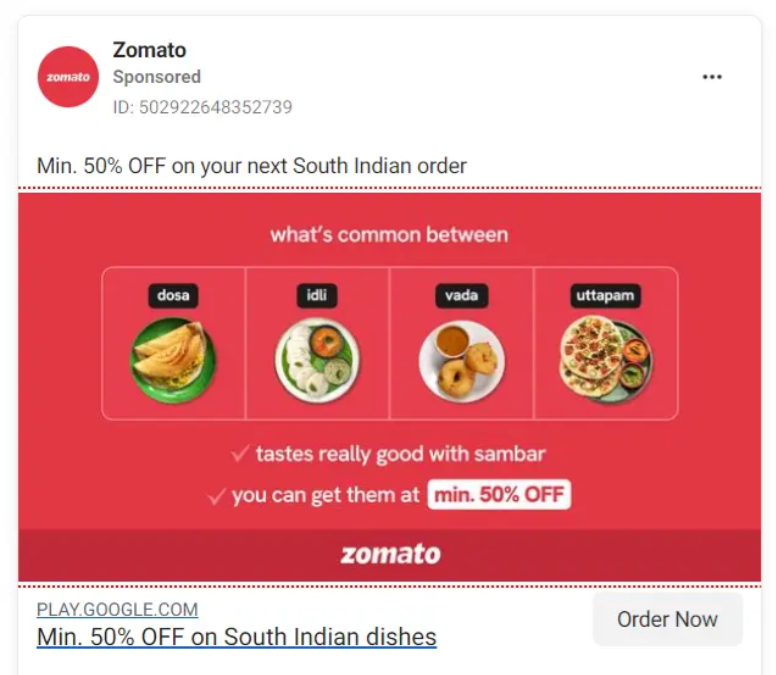
Zomato structures its online marketing channels comparison around distinct user states:
- Moment Marketing on Social Media: They use highly relatable, cultural notifications and quick-witted social posts to stay top-of-mind during peak lunch and dinner hours.
- High-Intent Search Dominance: When a user searches for “best restaurants near me” on Google, Zomato ensures clear visibility via localized SEO landing pages.
- Hyper-Personalized Retention: Their mobile app notifications and custom email workflows use precise behavioral data to prompt orders based on past dining history.
By treating these various types of digital marketing channels as an interconnected network rather than isolated experiments, they maintain a highly efficient customer acquisition and retention flywheel.
Paid vs Organic Marketing Channels
A major decision businesses face is choosing between paid and organic channels.
Organic Channels
Examples:
- SEO
- Content Marketing
- Organic Social Media
Advantages:
- Sustainable growth
- Builds trust
- Lower long-term acquisition costs
Challenges:
- Requires patience
- Needs consistent effort
Paid Channels
Examples:
- PPC
- Social Media Ads
- Display Advertising
Advantages:
- Faster visibility
- Advanced targeting
- Easier scalability
Challenges:
- Requires continuous spending
- Results depend on optimization
The most successful businesses usually combine both approaches.
How to Choose the Right Digital Marketing Channels for Your Business
There is no universal answer regarding the types of digital marketing channels. But there is a clear framework that makes the decision much less overwhelming.
How to Choose the Right Digital Marketing Channels
No universal answer. But a clear framework.
Mfg Owner
Skincare Fan
Email List
Accelerated Growth
Video, Influencer
Community
Review
Review honestly.
Step 1: Follow Your Customer, Not the Trend
Before you pick a channel, get very specific about where your customer actually spends time online. Not where you think they should be. Where they actually are. A 45-year-old manufacturing business owner in Ludhiana is not your Instagram audience. A 26-year-old skincare enthusiast in Mumbai probably is. Start there.
Step 2: Be Honest About Your Stage
Early-stage businesses with limited budgets and small teams should focus on channels that build long-term assets – SEO, content, and email list building. Use any digital marketing platforms comparison to confirm that these have the lowest cost-to-longevity ratio for your stage. Businesses with proven revenue and cash flow can then layer in paid channels like PPC and influencer marketing to accelerate growth.
Step 3: Align Each Channel to a Specific Goal
- Brand awareness: Social media, video marketing, influencer collaborations
- Lead generation: SEO, PPC, LinkedIn, content marketing
- Sales and conversion: PPC, email marketing, WhatsApp automation
- Customer retention: Email newsletters, WhatsApp broadcasts, community building
Step 4: Pick Two or Three Channels and Actually Master Them
This is the advice most people hear, agree with, and then ignore. Two or three channels done with real consistency and quality will always outperform eight channels done half-heartedly. Discipline beats breadth.
Step 5: Pick Two or Three Channels and Actually Master Them
Set a date every quarter to look at your numbers honestly. Which channels are actually driving leads, sales, or meaningful engagement? Put more into those. Cut or pause what is not working. Digital marketing is not set-and-forget – it rewards the businesses that pay attention and adapt.
Best Digital Marketing Channel Strategy for Indian Businesses
Indian businesses operate in a diverse and competitive digital market. A strong strategy usually combines multiple channels.
A practical approach:
For Startups:
- SEO
- Content marketing
- Social media
- Paid ads
For Local Businesses:
- Google Business Profile optimization
- Local SEO
- Social media marketing
For E-commerce Brands:
- PPC advertising
- Social media ads
- Email marketing
- Influencer partnerships
For Service-Based Businesses:
- SEO
- Content marketing
- Lead generation campaigns
- Email nurturing
The right combination depends on business goals, audience behaviour, and growth stage.
Future Trends in Digital Marketing Channels
Digital marketing continues to evolve with advancements in technology and consumer behaviour.
Important trends include:
- AI-powered marketing automation
- Personalized customer experiences
- Voice search optimization
- Video-first marketing
- Data-driven decision-making
- AI-assisted content creation
Businesses that adapt quickly and use data effectively will have a stronger competitive advantage.
How Get Marg Helps You Build the Right Channel Mix
Here is something we hear constantly from business owners who come to Get Marg: “We have been doing digital marketing for a year, and we are not sure what is actually working.”
That is a prioritization problem, not a marketing problem. And it is incredibly common.
Get Marg is a boutique digital marketing agency built specifically for Indian small businesses, D2C brands, startups, and service-based founders. We do not give everyone the same strategy and call it a package. We start by understanding your business, your customers, and where you are right now – and then we build a channel strategy that makes sense for your specific situation.
What working with Get Marg on your online marketing channels comparison actually looks like:
- A free brand and marketing audit to honestly assess where you stand today
- A clear map of your customer journey and which channels reach them at each stage
- A prioritized channel strategy with defined goals, realistic timelines, and budgets that match your reality
- Execution with full transparency — you will always know what we are doing and why
- Monthly performance reviews with real data, honest feedback, and strategy adjustments based on what is actually working
Whether you need SEO, content, social media, paid ads, WhatsApp automation, or someone to simply help you figure out where to start — Get Marg brings the expertise, the tools, and the Indian market understanding to make it work.fully integrated digital strategy, Get Marg brings the expertise, the tools, and the Indian market context to make it actually work for your business.
Conclusion
There is no perfect digital marketing channel. A real digital marketing channels comparison is not about finding the best one – it is about finding the right one for your business, your audience, and where you are right now.
SEO builds your foundation. PPC accelerates it. Social media keeps you visible and builds community. Email and WhatsApp convert and retain. Content establishes authority. Video builds trust. Influencer marketing amplifies reach. Any honest digital marketing platforms comparison will show you that together, in the right combination, these channels create something no single channel can deliver alone.
But only if you choose deliberately, execute consistently, and have the patience to let each channel do what it is actually designed to do.
Stop trying to be everywhere. Start showing up powerfully in the two or three places your customer actually is. And if you want a second opinion on which channels make sense for your specific business, Get Marg offers a free brand audit – no strings attached, no sales pressure, just honest advice.
Frequently Asked Questions (FAQ’s)
What are digital marketing channels?
Digital marketing channels are the platforms and methods businesses use to reach their audience online. The main types of digital marketing channels include SEO, paid ads, social media, email marketing, content marketing, video, influencer marketing, and WhatsApp.
Which digital marketing channel has the highest ROI?
Email marketing consistently delivers the highest ROI across most industries. For Indian small businesses specifically, WhatsApp marketing also delivers exceptional returns relative to its very low cost. That said, ROI depends heavily on how well each channel is executed for your specific audience.
How do I choose the right digital marketing channels for my business?
Start with your customer – understand where they actually spend time online. Then use a simple digital marketing platforms comparison to match channels to your goals and current business stage. Start with two or three channels, master them, measure results, and expand from there.
What is the difference between SEO and PPC?
SEO is organic – it takes months to build but delivers free, lasting traffic once you rank. PPC is paid – it delivers immediate results but disappears the moment you stop spending. Most growing businesses benefit from using both, with SEO as the long-term foundation and PPC for short-term acceleration.
Which digital marketing platforms work best for Indian small businesses?
For most Indian small businesses, a combination of SEO for long-term visibility, Instagram or LinkedIn for brand building, WhatsApp for direct customer communication, and email marketing for nurturing tends to deliver the strongest overall results. Any online marketing channels comparison built for the Indian market will point you toward this mix as a starting point.
How many digital marketing channels should a small business focus on?
Two to three maximum when you are starting out. Spreading limited resources across too many channels produces average results everywhere. Dominating two channels is far more valuable than being mediocre across five.
Is social media marketing better than SEO for small businesses?
They serve completely different purposes. Social media builds brand awareness and community. SEO builds organic search visibility that compounds over time. Most businesses need both – but at different stages and for different goals.
Can a small business do digital marketing without a large budget?
Absolutely. SEO, content marketing, organic social media, email marketing, and WhatsApp marketing can all deliver strong results with a modest budget. The key is choosing channels that build long-term assets and committing to quality and consistency over time.