
Keyword research with AI is changing how growing brands gain online visibility. For over two decades, the formula was beautifully simple: you found a highly searched phrase, optimized a piece of content around it, ranked in the top blue links, and collected a predictable stream of organic traffic. Today, that linear path is gone, replaced by a conversational layer that prioritizes instant synthesis over external clicks.
Modern consumer behavior has shifted dramatically toward conversational, long-tail inquiries that look less like choppy fragments and more like complete, contextual paragraphs. Users no longer type “best accounting software small business”; instead, they input multi-layered prompts into Large Language Models (LLMs), demanding highly personalized, filtered recommendations. To capture these high-intent shoppers, growing brands must completely overhaul their discovery process by embracing keyword research with AI.
Transitioning away from legacy databases toward real-time LLM analysis allows modern marketers to uncover semantic entities rather than just tracking static, isolated phrases. Traditional methods are completely blind to the intent clusters that power conversational systems. By building a forward-looking digital presence around conversational intent, startups and e-commerce brands can ensure their business remains discoverable wherever their audience chooses to search.
The Invisible Erosion of Traditional Search Metrics
The biggest challenge facing businesses today is relying on outdated SEO metrics that no longer reflect how people search online. Traditional keyword tools focus on historical search volume and exact-match queries, but modern users increasingly search through conversational and AI-powered interfaces.
As a result, many businesses see stable rankings while their actual website traffic declines. Search engines and AI assistants now provide direct answers within the search experience, reducing the need for users to click external links. This shift means that ranking for a keyword alone is no longer enough to drive visibility or conversions.
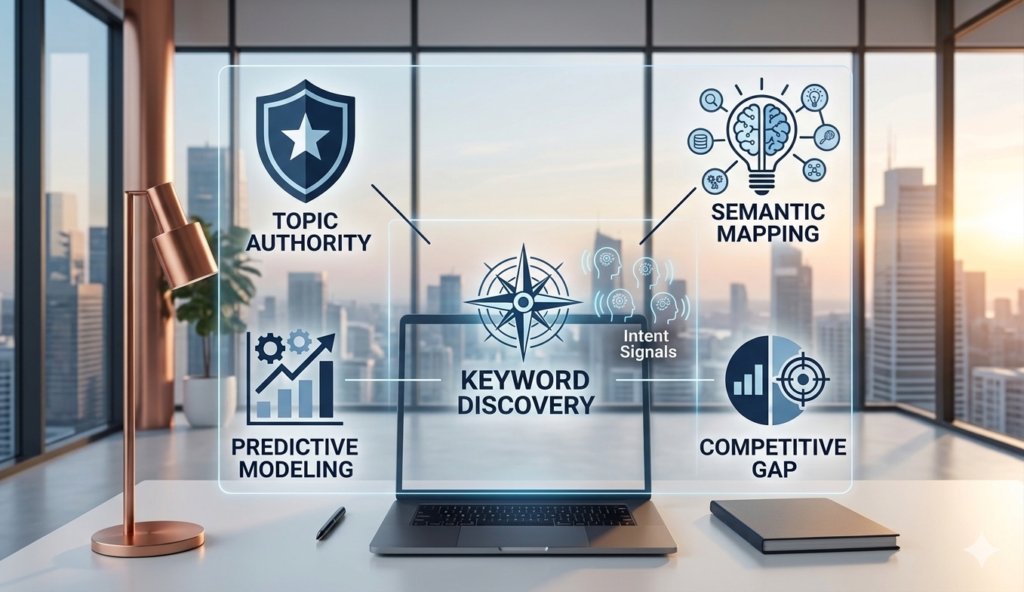
To succeed, brands must move beyond targeting isolated high-volume keywords and instead understand the broader topics, questions, and intent behind customer searches. The future of search and AI rewards businesses that build topical authority and create comprehensive content ecosystems. By focusing on connected concepts rather than individual keywords, brands can position themselves as trusted sources and remain discoverable in an increasingly AI-driven search landscape.
Why Future of Search and AI are Replacing the Blue Link Era
We are living through a massive behavioral shift driven by how digital platforms process information. Traditional search engines categorized the web by indexing exact word matches across pages, but modern conversational systems analyze the web conceptually, mapping relationships between entities, brands, and real-world problems. This paradigm shift means that hidden semantic patterns and long-tail intents are now far more valuable than broad, competitive terms.
Understanding the future of search and AI requires realizing that users now treat digital interfaces like trusted consultants. They ask complex, highly specific questions about their businesses, lifestyles, and challenges, expecting a curated response that blends options together. Traditional keyword indexes cannot predict these combinations, but an approach rooted in deep semantic understanding can easily anticipate them.
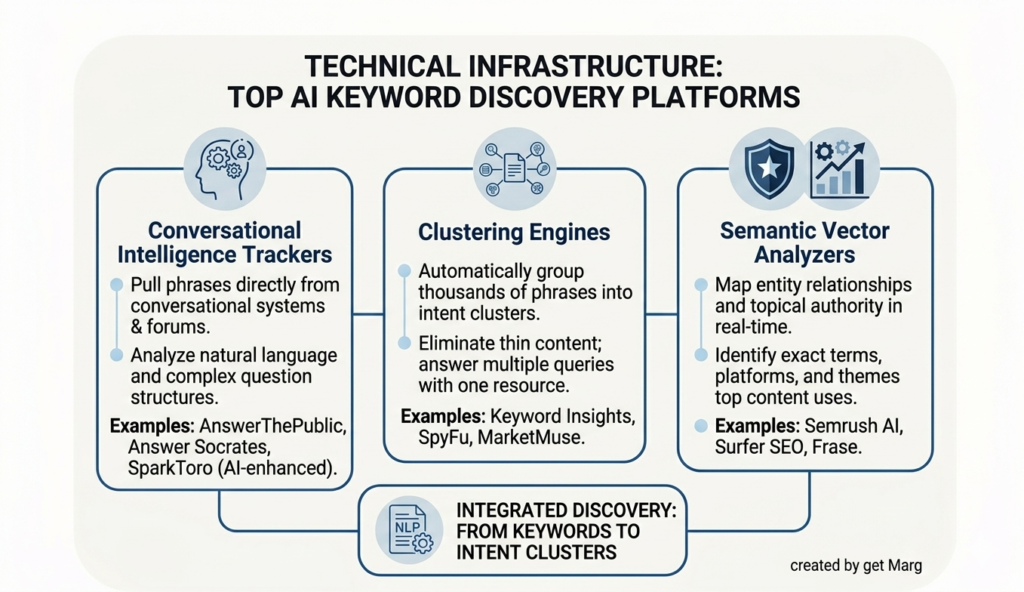
This structural evolution is why automated keyword generator platforms have become essential for modern content strategy. Instead of manually guessing every possible variation a customer might use, digital teams can utilize advanced tools to extract the underlying user intent clusters. This strategy ensures that your content addresses the exact core needs of your market, ensuring your brand is consistently cited as a primary source when AI systems synthesize answers.
How to Do Keyword Research with AI to Capture Modern Demand
Intent Clusters
Group related topics, questions, and user goals.
Entity SEO
Add important brands, tools, concepts, and terms.
Conversational SEO
Match the natural questions people ask AI.
Knowledge Architecture
Structure content for readers, search engines, and AI.
To build an agile digital footprint that excels across both conversational networks and traditional search engines, organizations must deploy a structured framework that views search behavior as a series of connected concepts rather than a simple checklist of terms. Learning how to do keyword research with AI requires shifting your focus from individual word strings to holistic topic ecosystems.
A modern discovery architecture relies on four fundamental pillars:
- Intent Cluster Mapping: Rather than selecting five disconnected target terms, use specialized AI keyword research tools to identify a single, primary conceptual theme. Map out all the peripheral questions, underlying fears, and explicit software dependencies your audience associates with that theme, creating an interconnected content ecosystem.
- Deep Entity Semantic Optimization: Identify the exact entities, key industry leaders, foundational terms, and related software platforms that conversational systems naturally pair with your niche. Weave these contextual details naturally into your content infrastructure to demonstrate true topical authority.
- Conversational Syntax Engineering: Analyze how real people phrase complex challenges when speaking out loud or interacting with conversational assistants. Structure your content headers and opening summaries to directly mirror these highly natural, multi-word question formats.
- Interactive Knowledge Architecture: Organize your digital resources to be easily scannable by both human readers and automated web crawlers. Utilize clean bullet points, structured comparison charts, and clear programmatic headers to ensure your core insights can be seamlessly extracted and cited.
What AI Keyword Research Tools Reveal About Modern User Habits
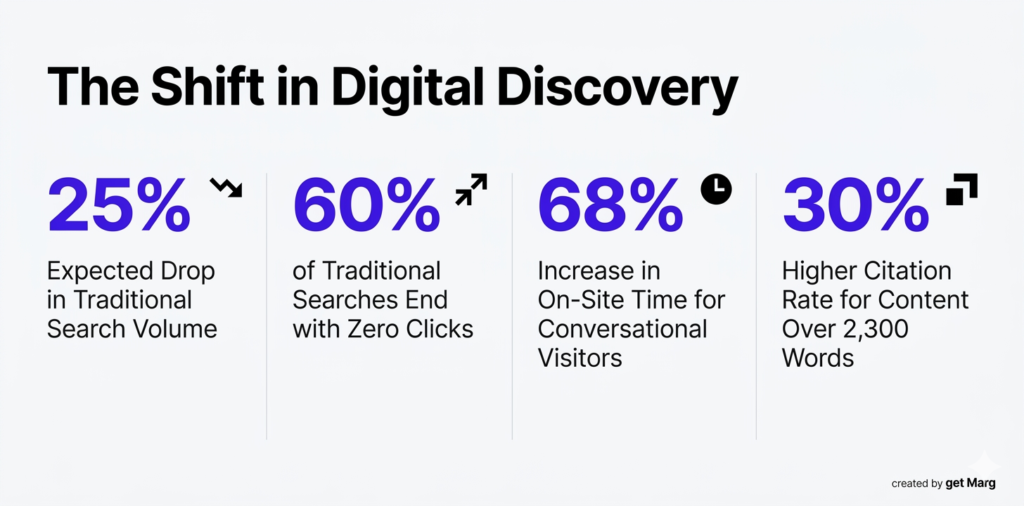
The metrics defining digital discovery have transformed significantly, shifting the balance of organic traffic and user engagement across the web. Modern AI keyword research tools allow us to quantify these behavioral shifts with extreme precision, showing a clear migration away from historical desktop patterns toward dynamic, real-time queries.
| Metric and Behavioral Shift | Impact on Modern Brand Strategy |
| Traditional Search Drop | Traditional search engine volume is projected to drop 25% due to the rise of AI assistants. |
| The Zero-Click Reality | Roughly 60% of traditional searches now end without a single click to an external website. |
| High-Intent Traffic Surge | Visitors arriving via conversational tools spend 68% more time on-site than traditional search traffic. |
| Long-Form Citation Value | Comprehensive articles over 2,300 words are 30% more likely to be selected as a featured source. |
The zero-click phenomenon highlights why surface-level content strategies are failing. When an online ecosystem satisfies user intent directly on the results page, generic content loses all its click-through potential. However, when your content is deeply analytical, comprehensive, and conceptually sound, conversational engines actively pull your brand into their summaries as a trusted source, delivering highly qualified traffic to your site. This is where partnering with an expert growth engine like GET Marg helps brands pivot, turning potential visibility losses into structured traffic gains.
Real-World Example: How Zapier Dominated Automated Keyword Generator Platforms
When evaluating how to execute keyword research with AI effectively, look at how the automated workflow giant Zapier transformed its organic footprint. For years, Zapier built one of the most successful programmatic SEO playbooks in history, creating thousands of landing pages for every imaginable application pairing, such as “Connect Slack to Google Sheets.”
As conversational search engines began rising in popularity, Zapier did not lose their dominant search presence; instead, their visibility expanded. They achieved this by ensuring their structured data, integration use cases, and workflow definitions were incredibly clear, semantic, and easy for large language models to ingest.
The primary lesson from Zapier’s approach is that they didn’t just chase abstract keywords. They built a highly organized, comprehensive repository of clear solutions for automation problems. Because their content was filled with specific entity associations, clean comparison tables, and logical answers to complex user problems, modern conversational engines consistently rely on Zapier as the definitive source for automation answers.
Why Outdated Strategies Fail the Future of Search and AI
- Chasing Vanity Metrics: Focusing exclusively on broad keyword volume statistics while completely ignoring how conversational intent shifts real human traffic away from traditional search links.
- Ignoring Long-Tail Context: Failing to realize that modern buyers use natural language sentences, which leaves your short, exact-match keyword content completely out of touch with modern search patterns.
- Relying on Generic AI Writing: Publishing generic, surface-level content using basic prompt tools without adding unique insights, proprietary data, or real human expertise.
- Isolating Target Phrases: Stuffing identical target phrases into disjointed paragraphs instead of naturally surrounding your primary concepts with a rich network of related terms.
- Neglecting Readability Infrastructure: Writing dense walls of text that lack clear bulleted systems, structured tables, and bold headers, making your content impossible for both users and modern scrapers to parse efficiently.
Implementing Automated Keyword Generator Platforms Today
Audit AI Results
Analyze AI recommendations and user questions.
AI Keyword Mapping
Discover hidden semantic opportunities.
Structure Content
Build clear semantic hierarchies.
Add Unique Data
Use statistics, insights, and case studies.
Build Topic Hubs
Connect pillar pages with supporting content.
Transitioning to a modern discovery model requires a methodical approach to content restructuring. By utilizing automated keyword generator platforms, small business owners and startup founders can efficiently bridge the gap between human user needs and algorithmic indexing requirements.
1.Audit Your Niche’s Conversational Footprint
Input your primary business offerings into major conversational platforms. Carefully analyze the top recommendations, follow-up questions, and cited sources to discover exactly how these systems currently categorize your niche.
2.Deploy Advanced Automated Keyword Generator Platforms
Use modern AI software to map out semantic keyword vectors, uncovering hidden consumer pain points that legacy search tools miss.
3.Restructure Content with Clear Semantic Hierarchies
Organize your articles using descriptive, natural language H2 and H3 headers that answer real-world user questions directly.
4.Enrich Every Piece of Content with Unique Data Points
Incorporate real statistics, specialized framework models, and specific real-world case studies to elevate your content’s informational value and authority.
5.Implement an Interconnected Topic-Hub Model
Build clean, comprehensive content networks where a central pillar resource links out to tightly focused supporting guides, establishing undeniable topical authority. Brands frequently leverage the technical consulting teams at GET Marg to build out these advanced internal frameworks smoothly.
The Shift in Digital Discovery
The way users find information is fundamentally changing. As conversational AI engines rise, traditional search strategies must evolve to keep pace. Here is what you need to know to stay ahead:
1. The Evolving Search Landscape
- The Decline of Traditional Search: Search volume on legacy platforms is dropping as users flock to conversational engines for direct answers.
- The Reality of Vanity Metrics: Surface-level traffic numbers can be deceiving—they often mask a significant drop in real, organic click-through performance across your site.
- Higher Engagement, Better Conversions: It’s not all bad news. High-intent buyers arriving via conversational recommendations show significantly better on-site engagement and conversion rates.
2. Modern SEO & AI Content Strategy
- Targeting Conversational Intent: To capture modern traffic, digital discovery now requires a deliberate shift toward keyword research powered by AI.
- Leveraging Automation: Traditional keyword lists aren’t enough. Modern teams must use automated keyword generator platforms to map out the complex, semantic networks that buyers actually use.
- Optimizing for AI Citations: If you want conversational systems to source your brand, your content must feature clear structured tables, bulleted lists, and deep entity optimization.
- Building Deep Topical Authority: Stop tracking isolated, exact-match terms. True authority is built by creating deep, data-rich content ecosystems that cover subjects comprehensively.
Thriving in the Next Era of Digital Growth
Succeeding in this changing digital environment requires a shift in perspective. True search visibility isn’t about gaming an algorithm or scattering exact-match phrases across a page. It is about understanding the core problems your target audience faces and providing the most comprehensive, accessible, and structured solutions available online.
As digital systems become more conversational, clear and deeply informative content will always stand out. By moving away from rigid, outdated SEO playbooks and adopting an agile approach to digital discovery, your business can build a resilient online presence. Focus on delivering genuine expertise, organizing your insights clearly, and ensuring your brand remains top-of-mind wherever your next customer chooses to explore.
Build a Future-Proof Search Strategy with GET Marg
Navigating the rapid shifts in modern digital discovery can feel overwhelming for growing brands. As traditional search models evolve into conversational ecosystems, running an outdated organic playbook can quickly make your business invisible online. You need a forward-looking digital partner who understands semantic search, intent clustering, and the future of search and AI.
At GET Marg, we help small businesses, ambitious startups, and growing e-commerce platforms transform their organic performance. We move past old exact-match strategies to build deep, data-rich content hubs that establish true topical authority. Whether you need to optimize for modern search summaries, scale your performance marketing, or design a comprehensive digital growth strategy, we ensure your brand stands out to high-intent buyers. Let GET Marg help you navigate the future of digital marketing and turn search changes into sustainable business growth.
Frequently Asked Questions(FAQs)
Q1. Can I use AI for keyword research?
Yes, AI can significantly improve keyword research with AI by identifying search trends, user intent, and content opportunities. Modern AI keyword research tools analyze vast amounts of data quickly, helping marketers discover high-value keywords and create more effective SEO strategies.
Q2. Which AI is best for keyword research?
Popular AI keyword research tools include ChatGPT, Semrush, Ahrefs, Surfer SEO, and Jasper. These platforms function as advanced automated keyword generator platforms, helping users find keyword ideas, analyze search intent, and build content strategies efficiently.
Q3. Can ChatGPT do keyword research?
Yes, ChatGPT can support keyword research with AI by generating keyword ideas, topic clusters, and long-tail variations. If you’re learning how to do keyword research with AI, ChatGPT is useful for brainstorming, though SEO tools are needed for search volume data.
Q4. What are the 4 types of keywords?
The four main keyword types are informational, navigational, commercial, and transactional. Understanding these categories is essential when learning how to do keyword research with AI, as they help align content with user intent and search behavior.
Q5. How does keyword research with AI differ from traditional SEO methods?
Keyword research with AI uses machine learning to analyze trends, search intent, and semantic relationships faster than manual methods. As part of the future of search and AI, it provides deeper insights and more accurate keyword recommendations than traditional SEO approaches.