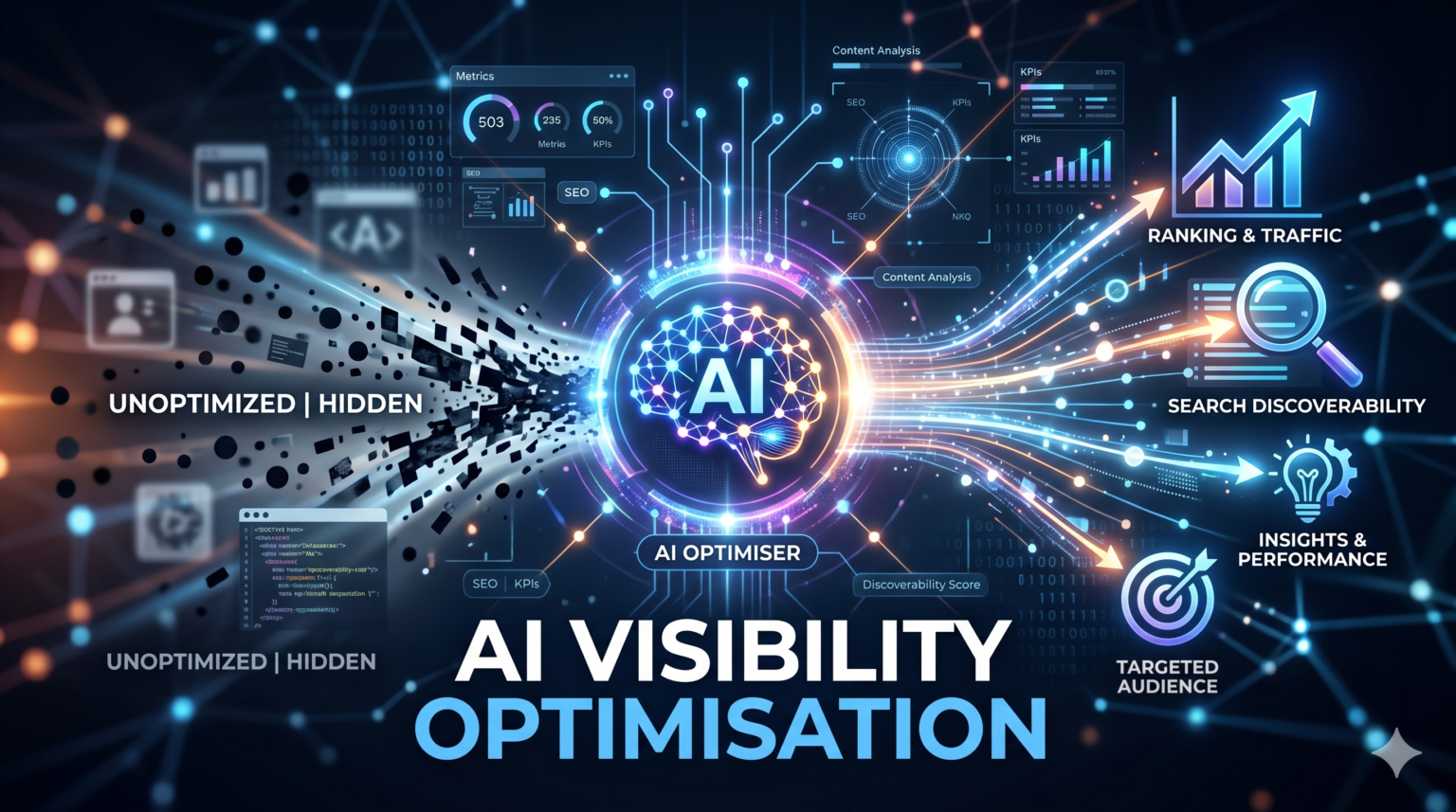
Introduction: The Shift from Search Engines to Answer Engines
The way people search for information online is changing rapidly. For decades, businesses relied on traditional search engine optimisation (SEO) to improve rankings on Google and attract website visitors. The strategy was simple: rank higher, earn clicks, and convert visitors into customers.
Today, however, users are increasingly turning to AI-powered search platforms such as ChatGPT, Google AI Overviews, Gemini, and Perplexity to get direct answers to their questions. Instead of browsing multiple websites, users can now receive instant, AI-generated responses summarising information from various sources.
This shift is transforming how businesses get discovered online. As a result, brands need a new approach to digital visibility. This is where AI Visibility Optimisation comes into play.
In this guide, you’ll learn what AI Visibility Optimisation is, how it differs from traditional SEO, why platforms like ChatGPT and Google AI Overviews are reshaping online discovery, and what businesses can do to improve their AI Search Visibility in 2026 and beyond.
What Is AI Visibility Optimisation?
AI Visibility Optimization (AIVO) is the process of improving a brand’s presence, discoverability, and authority across AI-powered search engines and generative AI platforms.
Unlike traditional SEO, which focuses on improving rankings in search engine results pages, AI Visibility Optimization focuses on ensuring that AI systems recognize, trust, and recommend your brand when generating answers.
In simple terms:
- SEO helps users find your website.
- AI Visibility Optimization helps AI platforms find and recommend your business.
As AI-powered search continues to grow, businesses that appear in AI-generated responses gain a significant competitive advantage.
Why AI Visibility Optimization Matters in 2026
Consumer behavior has evolved dramatically over the past few years. People increasingly trust AI-generated recommendations when researching products, services, and solutions.
Instead of searching for “best CRM software” and reviewing ten different websites, users now ask:
“What is the best CRM software for a growing business?”
The AI platform then provides a summarized recommendation. This change means businesses need to optimise for AI-generated answers, not just traditional search rankings. Organisations that ignore this shift risk losing visibility, traffic, and potential customers to competitors that have already adapted.
The Rise of AI-Powered Search
AI-powered search is becoming the new standard for online discovery.
Major platforms driving this transformation include:
- ChatGPT
- Google AI Overviews
- Gemini
- Perplexity
- Microsoft Copilot
These platforms use artificial intelligence to understand user intent, analyze information from multiple sources, and provide comprehensive answers in seconds. As users increasingly adopt these tools, businesses must ensure they are visible where these conversations are happening.
The Disconnect Between Traditional SEO and Modern Search
Most Indian SMB founders, marketing heads, and B2B SaaS leaders are still executing strategies built for a totally different era. You might have excellent content published on your blog, but if it only ranks as a standard blue link, your ideal buyer might never actually see it. AI Visibility Optimization requires a complete recalibration of how you define successful search performance.
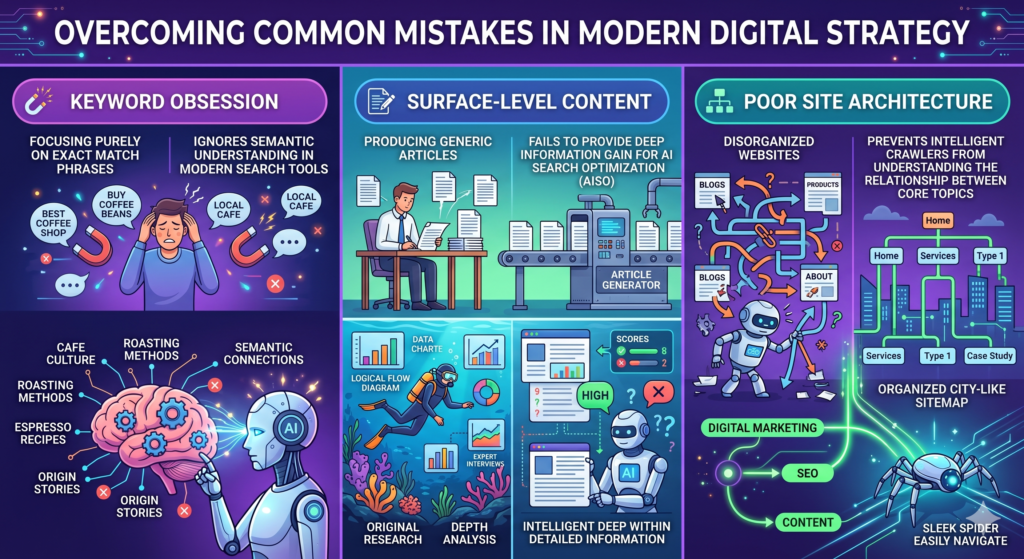
To understand this disconnect, we must look at the specific points of failure in legacy strategies:
- Keyword obsession: Focusing purely on exact match phrases ignores the semantic understanding of modern search tools.
- Surface-level content: Producing generic articles fails to provide the deep information gain required for AI Search Optimization.
- Poor site architecture: Disorganized websites prevent intelligent crawlers from understanding the relationship between your core business topics.
Why AI Search Optimization Demands a New Approach
The internet is rapidly shifting from search engines to answer engines, fundamentally altering how information is served to users. When you prioritize AI Search Optimization, you are essentially training language models to understand your brand as the definitive source of truth in your specific niche.
This transition requires a firm grasp of Generative Engine Optimization (GEO) and a commitment to structuring your data effectively.
- Context over exact matches: AI models look for semantic meaning and comprehensive topic coverage rather than repeated phrases.
- Trust and verification: Platforms heavily prioritize content that provides clear, factual backing and recognizable brand authority.
- Conversational phrasing: User queries are becoming longer, highly specific, and entirely conversational in nature.
Data Behind AI Search Visibility
The numbers tell a compelling story about exactly where digital discovery is heading for professional services and corporate agencies. Adapting your strategy to prioritize AI Search Visibility is backed by significant, undeniable market shifts and shifting consumer habits.
Gartner predicts that traditional search engine traffic will drop by 25 per cent by 2026 due to the rise of intelligent answer alternatives. Meanwhile, HubSpot reports that the vast majority of marketing leaders now see the integration of artificial intelligence as essential to their future growth. Furthermore, Statista data highlights that generative AI adoption among businesses has doubled in the last year alone.
The Evolution of Digital Discovery
| Search Era | Primary Focus | User Behavior | Core Metric |
| Traditional SEO | Keywords and Backlinks | Browsing multiple tabs | Organic Traffic |
| AI-Powered Search | Entities and Citations | Reading instant summaries | Brand Mentions |
| Future State | Conversational AI | Direct voice and text dialogue | AI Recommendations |
Blueprint for AI Visibility Optimisation
Building a resilient digital presence requires a highly structured, operational approach to your content strategy. Here is the framework to ensure your brand stands out prominently within modern AI-Powered Search environments.
1. Establish Clear Entities Entity SEO is about defining exactly what your brand is, what specific services you sell, and who you serve. This clarity helps language models categorize your business accurately within their massive knowledge graphs.
2. Optimize for Answers Answer Engine Optimization (AEO) means directly answering the exact questions your target audience is asking. You must format your content with clear question-and-answer structures that are easy for machines to extract.
3. Secure High-Quality Citations AI Citation Optimization involves getting your brand mentioned on authoritative, high-trust third-party websites. AI models cross-reference these external mentions to verify your credibility and industry standing.
4. Target Specific Platforms Do not just optimize for one single search provider. ChatGPT SEO and Perplexity SEO are becoming equally critical as B2B buyers increasingly use these specific tools for deep research and vendor comparison.
How Notion Mastered Answer Engine Optimisation (AEO)
The productivity software company Notion provides a perfect, real-world example of how to win in this complex modern search landscape. Instead of just creating generic blog posts about workplace productivity, they focused deeply on user intent, clear formatting, and highly structured data.
Notion created specific template galleries and detailed help center articles that directly answered conversational queries. When a user asks an AI tool how to organize a marketing calendar, the language model frequently pulls from Notion’s structured databases because the information is perfectly formatted for extraction.
Here is exactly what Notion did right to secure their visibility:
- Clear formatting: They utilized distinct headings, short paragraphs, and bulleted lists that AI models could easily parse.
- Direct answers: They prioritized Answer Engine Optimization (AEO) by avoiding unnecessary filler content and getting straight to the point.
- Authoritative linking: Their logical internal linking structure made it incredibly simple for crawlers to understand the relationships between different product features.
How AI Platforms Choose and Cite Sources
Not all AI platforms choose sources the same way. Knowing how each platform selects and cites information can help you increase your chances of being featured in AI-generated answers.
| AI Platform | How It References Content | Content It Commonly Prefers | Key Visibility Signals |
|---|---|---|---|
| ChatGPT | Uses inline citations and source references when available | Comprehensive, authoritative, and educational content | Strong brand authority, topical expertise, and factual accuracy |
| Perplexity | Provides direct source links and citations within responses | Practical content, real-world examples, and up-to-date information | Content freshness, credibility, and source diversity |
| Google AI Overviews | Integrates source links within AI-generated summaries | Structured content, featured snippet-style answers, and authoritative resources | Schema markup, E-E-A-T, and topical authority |
| Claude | References trusted web sources and contextual information | Clear, well-organized, and easy-to-understand content | Content quality, source trustworthiness, and clarity |
| Gemini | Combines AI-generated responses with Google Search signals | Google-indexed content with strong relevance and authority | Traditional SEO signals, expertise, and content freshness |
| Microsoft Copilot | Uses Bing-powered citations and references | News-driven, authoritative, and frequently updated content | Bing visibility, timeliness, and domain credibility |
How Strong Google Rankings Improve AI Visibility
There is a strong link between Google search rankings and AI citations. Content that appears on Google’s first page has a much better chance of being cited in AI-generated answers. This happens for several reasons:
- Shared quality signals. The same factors that help content rank well on Google, such as authority, completeness, and freshness, are also the ones AI engines use to pick citations.
- Training data overlap. Many AI models were trained on data that includes Google search results and the web pages that perform well for popular queries.
- Real-time search integration. Platforms like ChatGPT Search, Perplexity, and Google AI Overviews actively search the web and often pull information from top-ranking results.
This means your SEO efforts are not wasted when you work on AI visibility. They build on each other. A page that ranks well on Google and is optimized for AI citations has two ways to reach your audience instead of just one.
Why Your Current Strategy Fails at AI Citation Optimization
Many professional services and e-commerce brands struggle to adapt because they cling tightly to outdated marketing habits. Understanding what you are doing wrong is the first vital step toward achieving true AI Visibility Optimization and dominating your niche.
Here are the most common strategic failures happening right now:
- Ignoring Entity SEO: Failing to clearly define your core brand attributes across the web confuses language models and dilutes your authority.
- Producing thin content: Shallow, generic articles do not provide enough context or genuine information gain for Generative Engine Optimization (GEO) to work effectively.
- Forgetting about Perplexity SEO: Treating traditional search as your only traffic source ignores a massive segment of early adopters and tech-savvy founders.
- Poor visual formatting: Large, unbroken blocks of text without bullet points or tables are extremely difficult for AI systems to parse and summarize accurately.
Steps to Improve Your AI Visibility Optimization Today
You need to move quickly beyond theoretical concepts and start implementing concrete changes to your digital properties immediately. Taking action now ensures you establish a strong foundation before your competitors realize what is happening.
1. Audit your current content footprint Review your top-performing pages and ensure they directly answer common customer questions to improve your Answer Engine Optimization (AEO). A comprehensive digital audit is always the most effective starting point for this transformation.
2. Restructure for maximum readability Break up long paragraphs systematically. Use clear headings, bullet points, and data tables to make your content incredibly easy to extract for Google AI Overviews.
3. Build authoritative industry mentions Focus heavily on AI Citation Optimization by securing natural mentions in industry reports, press releases, and highly reputable business directories.
4. Monitor your brand sentiment Regularly check what conversational AI tools say about your brand when prompted. This active monitoring is a crucial, ongoing part of successful ChatGPT SEO.
Core Principles of AI-Powered Search
Keep these fundamental truths top of mind as you update your digital growth strategy for the coming year. AI Visibility Optimisation requires a shift in mindset just as much as a shift in tactics.
- Focus on the user: Always write for humans first, but strictly structure your data for machines.
- Embrace new platforms: Strategies like Perplexity SEO and ChatGPT SEO require active monitoring and constant adjustment.
- Prioritize depth over volume: Genuine information gain is the most valuable currency in Generative Engine Optimization (GEO).
- Verify your facts: Factual accuracy and strong AI Citation Optimization are completely non-negotiable for building trust.
- Adapt continuously: AI Visibility Optimization is an ongoing operational process, not a one-time marketing project.
Build Your AI Visibility With GET Marg
Navigating these rapid changes in digital behavior can feel complicated when you are simply trying to run and scale a business. That is exactly where GET Marg steps in to help you manage the complexities of modern search, content strategy, and long-term digital growth. If you are ready to make sure your brand is the definitive answer people find, reach out to our team at GET Marg today to discuss a strategy that fits your exact goals.
Conclusion
The way people search online is changing. Platforms like ChatGPT, Google AI Overviews, Gemini, and Perplexity are increasingly influencing how users discover brands, compare solutions, and make buying decisions. As AI-powered search becomes more mainstream, businesses can no longer rely solely on traditional SEO. AI Visibility Optimization is emerging as a critical strategy for ensuring your brand appears in AI-generated answers and recommendations.
By combining AI Search Optimisation, Generative Engine Optimization (GEO), Answer Engine Optimization (AEO), Entity SEO, and AI Citation Optimization, businesses can improve their AI Search Visibility and build stronger digital authority. For Indian SMBs, startups, agencies, and growing brands, investing in AI Visibility Optimization today can create a lasting competitive advantage. At GET Marg, we believe brands that adapt to this shift early will be best positioned to succeed in an AI-first search landscape.
Frequently Asked Questions (FAQ’s)
What is AI Visibility Optimization?
AI Visibility Optimization is the process of making your brand more discoverable across AI-powered platforms like ChatGPT, Google AI Overviews, Gemini, and Perplexity. The goal is to help AI systems recognize, trust, and recommend your business when users ask relevant questions.
How is AI Visibility Optimization different from SEO?
SEO helps your website rank higher in search results, while AI Visibility Optimization helps your brand appear in AI-generated answers. Both are important, but AI visibility focuses on recommendations, citations, and authority rather than rankings alone.
How can my business appear in ChatGPT and other AI tools?
To improve your chances of appearing in AI-generated answers, create helpful content, build industry authority, maintain consistent brand information, and earn mentions from trusted websites.
What are Google AI Overviews?
Google AI Overviews are AI-generated summaries that appear at the top of some search results. They provide quick answers to user queries and often reference information from trusted websites.
What is the difference between SEO, AEO, and GEO?
SEO focuses on search rankings, AEO (Answer Engine Optimization) focuses on answering user questions, and GEO (Generative Engine Optimization) focuses on increasing visibility in AI-generated responses. Together, they support stronger AI Visibility Optimization.
Why is my website ranking on Google but not showing in AI answers?
AI platforms look beyond rankings. They also consider factors like content quality, authority, brand mentions, Entity SEO, and trust signals when deciding which sources to reference.
How can I improve my AI Search Visibility?
Focus on creating valuable content, answering customer questions, building topical authority, strengthening Entity SEO, and publishing original insights that AI systems can trust and cite.
Is AI Visibility Optimization worth investing in?
Yes. As more people use AI-powered search to research products and services, businesses that appear in AI-generated recommendations can gain more visibility, credibility, and potential customers.