How to rank in Google AI Overviews is the question every Indian founder and marketer should be asking right now. Because someone just Googled something your business could have answered perfectly. Google summarised it, put it at the top of the page, and your site wasn’t mentioned. The user got their answer and moved on.
A few years ago, getting on the first page of Google felt like winning.
Today, even ranking #1 doesn’t guarantee the clicks.
Why?
Because Google is increasingly answering questions directly inside search results through AI Overviews.
Someone searches:
“What is performance marketing?”
“Best CRM for small businesses”
“How much does SEO cost in India?”
And Google often generates a detailed AI answer before users even reach the traditional organic listings.
For business owners, marketers, and agencies, this creates an obvious question:
How do you get your content featured inside Google AI Overviews?
The good news is that AI Overviews aren’t replacing SEO.
They’re changing what good SEO looks like.
The websites that understand this shift early will gain visibility, while others keep chasing rankings that bring fewer clicks than before.
Let’s break down what actually works.
What Are Google AI Overviews?
Google AI Overviews are AI-generated summaries that appear at the top of search results for many informational queries. These summaries pull information from multiple sources and present a direct answer to the user.
Think of them as Google’s attempt to answer a question immediately instead of making users open ten different tabs.
The AI overview often includes:
- Summarized answers
- Source citations
- Supporting links
- Follow-up questions
- Related topics
For businesses, appearing as one of those cited sources can drive authority, visibility, and qualified traffic.
Why Ranking in AI Overviews Matters Right Now?
Many marketers are still measuring success using traditional rankings.
That’s becoming risky.
Users are changing their search behaviour.
Instead of clicking several websites, they often read the AI-generated answer first.
Industry studies throughout 2025 and 2026 have consistently shown shifts in click patterns as AI-generated search experiences become more common.
The result?
This isn’t just about Google.
You can technically rank well but still lose visibility if your content isn’t being referenced by AI systems.
The same trend is happening across:
- ChatGPT Search
- Perplexity
- AI-powered search engines
- Voice assistants
- AI agents
The bigger picture is simple.
The internet is moving from “ranking pages” to “citing sources.”
That’s a very different game.
How Google Chooses Sources for AI Overviews
Nobody outside Google knows the exact formula.
But after analyzing hundreds of AI Overview results, some patterns are becoming obvious.
Google tends to favor content that is:
- Clear
- Structured
- Factually accurate
- Topically relevant
- Easy to extract information from
- Supported by expertise signals
Notice what’s missing from that list.
Keyword stuffing.
Over-optimised content.
Articles written purely for search engines.
AI systems prefer content they can confidently understand and summarise.
If your article feels confusing, repetitive, or vague, it becomes much harder for AI to use.
The Biggest Mistake Businesses Make
Most content teams are still writing for rankings.
Not for answers.
Here’s what usually happens.
Someone targets a keyword like:
“Digital marketing for small business”
Then they create a 3,000-word article filled with generic advice, stock examples, and fluffy introductions.
The article technically targets the keyword.
But does it clearly answer real questions?
Not always.
AI systems reward clarity.
If your content answers questions faster and better than competitors, your chances improve significantly.
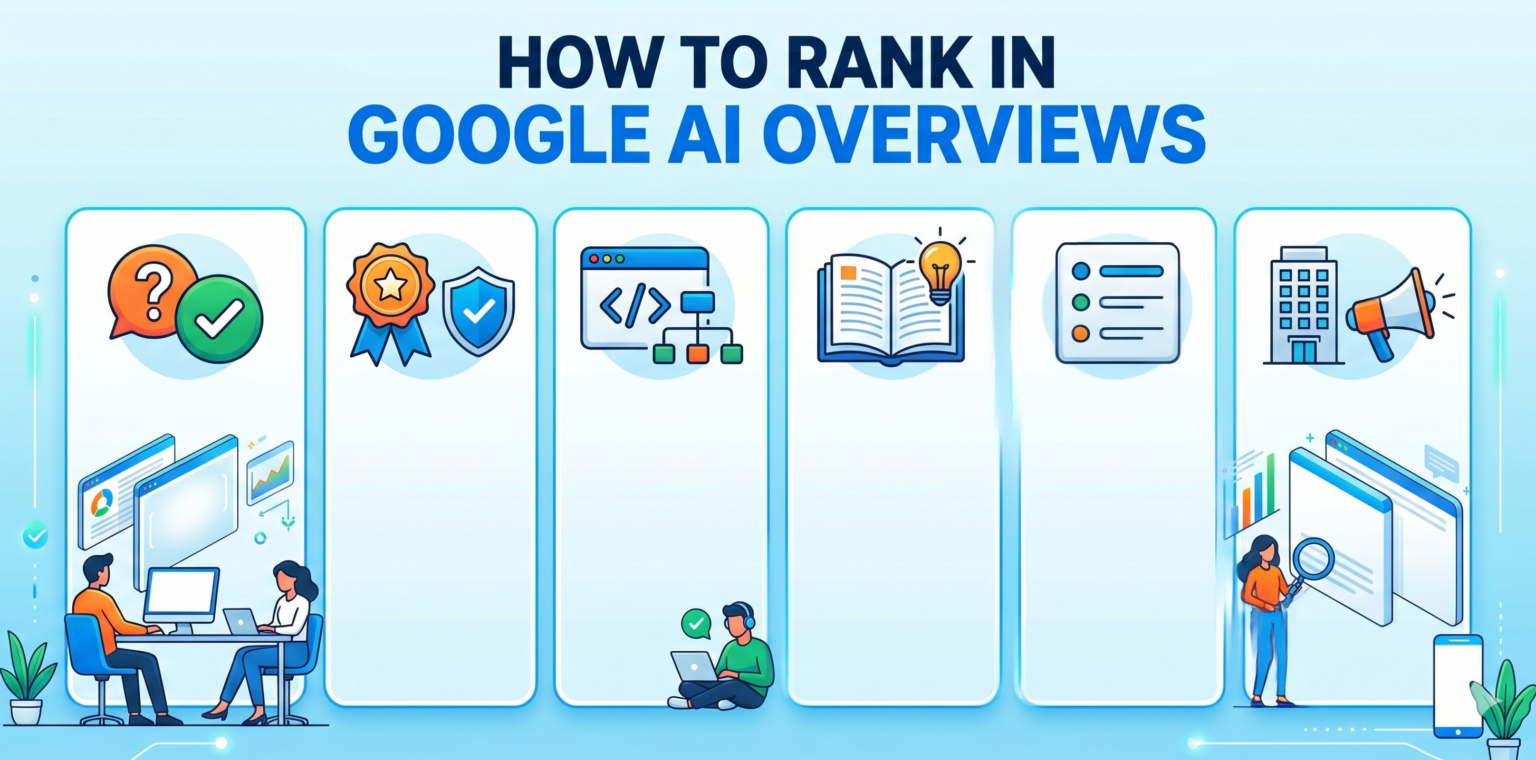
How to Rank in Google AI Overviews?
1. Start With Questions, Not Keywords
Traditional SEO starts with keywords.
AI visibility starts with questions.
Before writing anything, ask:
- What is the user trying to understand?
- What follow-up questions will they ask?
- What confusion are they trying to resolve?
For example:
Instead of targeting:
AI marketing
Focus on:
- What is AI marketing?
- How does AI marketing work?
- What are examples of AI marketing?
- Is AI marketing useful for small businesses?
Each question becomes a section.
Each section becomes an answer that AI can easily extract.
2. Put the Answer Near the Top
One thing shows up repeatedly in AI-cited content.
The answer comes first.
Not after a long introduction.
Not buried halfway through the article.
For example:
3. What Is Programmatic Advertising?
Programmatic advertising is the automated buying and selling of digital ad inventory using software and real-time bidding systems.
That’s it.
Simple.
Direct.
Easy to quote.
Easy for AI systems to understand.
Then you can expand with examples and deeper explanations.
4. Create Snippet-Friendly Content
Google AI Overviews often pull information from content that already works well for featured snippets.
Use formats like:
Definitions
Keep them under 50 words when possible.
Lists
Use numbered steps.
Comparison Tables
| Traditional SEO | AI Visibility SEO |
|---|---|
| Focus on rankings | Focus on citations |
| Keywords first | Questions first |
| Traffic-centric | Authority-centric |
Step-by-Step Frameworks
AI systems love structured information.
Humans do too.
5. Build Topical Depth
One article isn’t enough anymore.
Google wants evidence that your website genuinely understands a topic.
Let’s say you run a digital marketing agency.
Don’t publish one article about AI search.
Create an ecosystem.
Examples:
- AI Overviews explained
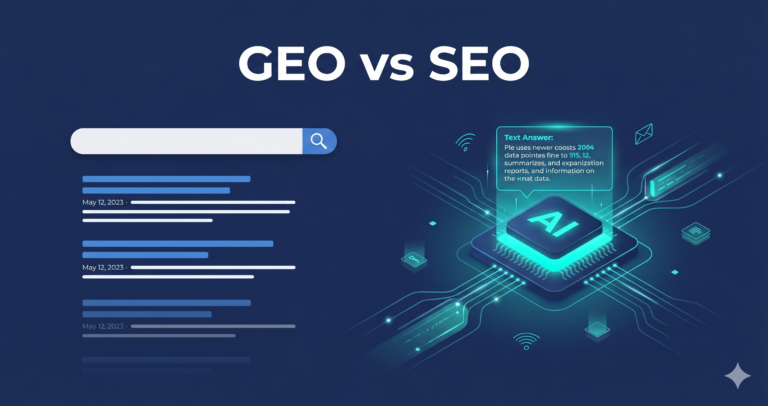
- GEO vs SEO
- AI search optimization
- ChatGPT visibility
- Perplexity ranking factors
- AI content citation strategies
- Future of search
This creates topical authority.
And authority matters more than ever.
5. Use Real Examples
Generic advice rarely gets cited.
Specific examples do.
Instead of saying:
“Businesses can improve content quality.”
Say:
“A local SaaS company publishing detailed pricing comparisons often has a better chance of being cited than a generic homepage describing software features.”
Specificity builds trust.
Trust increases citation potential.
6. Demonstrate Experience
This is becoming a huge factor.
Google increasingly values content that reflects actual experience.
Share:
- Client observations
- Campaign learnings
- Industry experiments
- Original insights
- Data-driven findings
A surprising number of articles simply repeat what everyone else says.
AI systems are getting better at recognizing that.
Originality matters.
7. Strengthen Your E-E-A-T Signals
E-E-A-T stands for:
- Experience
- Expertise
- Authoritativeness
- Trustworthiness
For businesses, this means:
Add Author Information
Show who wrote the content.
Include Company Details
Build credibility.
Cite Reliable Sources
Support important claims.
Keep Content Updated
Fresh information matters.
Especially in AI-related industries, where things change fast.
8. Optimize for Conversational Search
People don’t search like they did five years ago.
They’re asking complete questions.
Examples:
- Which CRM is best for startups in India?
- How much should a small business spend on SEO?
- Can AI replace content writers?
Your content should reflect these natural language patterns.
This helps both AI search engines and traditional search.
9. Create Content AI Can Quote
This sounds obvious.
Yet most websites miss it.
Ask yourself:
“If an AI system needed a two-sentence answer, would it find one?”
Every major section should contain concise answer blocks.
Example:
Can AI Overviews Increase Website Traffic?
Yes. Websites cited in AI Overviews can gain visibility, brand recognition, and qualified traffic, especially when users want deeper information beyond the summarized answer.
Simple.
Clear.
Ready for extraction.
10. Focus on Authority, Not Just Volume
Publishing 100 average articles won’t help much.
Publishing 20 genuinely useful articles might.
Many businesses are trapped in content production mode.
More blogs.
More keywords.
More pages.
The websites winning AI visibility are often producing fewer pieces with greater depth and stronger expertise.
Quality is becoming a competitive advantage again.
What the Future Looks Like?
Search is not going back to what it was. Accept that first.
AI Overviews started with informational queries. By late 2025, they were influencing commercial decisions, product comparisons, agency shortlists, software trials. The AI is moving deeper into the buying journey and it’s not slowing down.
India’s AI search usage is growing at over 200% year over year. Your customers are already changing how they find information. Most of your competitors haven’t noticed yet. That’s the window.
Citation authority also compounds. Brands getting cited today will be harder to displace next year because the system keeps reinforcing what it already trusts. The head start matters more than people think.
Conclusion
You don’t need to be a big brand to show up in AI Overviews. You need to be useful, specific, and structured. That’s available to any business willing to do the work.
Start with what you have. Update your best pages. Add FAQ sections. Put a real author bio on your articles. Write one genuinely useful LinkedIn post this week. None of it is complicated.
The businesses that figure this out in 2026 will be the ones people are asking AI about in 2028. Your call.
Frequently Asked Questions (FAQ’s)
Can a small business or startup actually rank in Google AI Overviews?
Yes. Google’s AI doesn’t automatically favour big brands. It favours well-structured, specific, and credible content. A focused SMB with a clear niche and properly formatted content can get cited over a large site with generic information. The playing field is more open than most people think.
My content ranks on page one, but still doesn’t appear in AI Overviews. Why?
Ranking and being cited are two different things now. Studies show the overlap between top 10 organic rankings and AI Overview citations has dropped to as low as 17% for some query types. You can rank first and still not be cited. AI Overviews look for answer-first structure, content freshness, and author credibility, not just ranking position.
How do I check if my site is being cited in AI Overviews
Google Search Console added an AI Overviews filter in its Performance report in late 2025. Go to Performance, filter by Search Type, and look for AI Overviews data. Third-party tools like Semrush and Ahrefs also have AI Overview tracking features that show competitor citations too.
Does using AI to write content hurt my chances of appearing in AI Overviews?
Not automatically. Google’s John Mueller said in November 2025 that their systems don’t care if content is written by AI or humans. What matters is whether it’s genuinely helpful. The problem is that most AI-generated content is generic and lacks real expertise signals. That’s what hurts rankings, not the AI origin itself.
What type of queries trigger Google AI Overviews the most?
Question-format queries trigger AI Overviews most often. Around 57.9% of AI Overview queries are question-based. Long-tail queries of 8 words or more are 7 times more likely to trigger an AI Overview than short queries. Conversational phrases like “how to,” “what is the best,” “why does,” and “what’s the difference between” are strong triggers.
Does adding videos or images help with AI Overview visibility?
Yes, significantly. Pages combining text, original images, video, and proper schema show much higher AI Overview selection rates. YouTube is now one of the most cited sources by major AI systems. Embedding a short, relevant video under key sections of your article is one of the higher-leverage things you can do right now.
Is there a risk of getting too much traffic from AI Overviews and not enough direct clicks?
That’s the reality of AI search right now. Being cited in an AI Overview doesn’t always mean users click through to your site. But it does mean your brand name shows up in the answer. That builds recall, trust, and branded search over time. Brands cited in AI responses also see higher paid CTR, so the halo effect is real even when direct organic clicks don’t follow.